
TL;DR
AI resume screening software uses a criteria weighted matching engine, not keyword counting, to rank candidates by Fit and surface identity risk before a recruiter reviews an application.
- Most AI resume screening software still sorts resumes by how many keywords overlap with the job description, which rewards resume writing skill over actual fit.
- A semantic, criteria based model reads context: it can tell the difference between a candidate who used a skill and one who only mentioned it.
- The best AI resume screening software also checks who is applying, not just how well they match the role, since fit and identity are separate signals.
- 2026's shift toward agentic AI in recruiting changes sourcing and scheduling more than it changes the core question of who to trust with a Fit ranking.
- Switching to better AI resume screening software doesn't have to mean switching ATS platforms, since it can run on top of the one a team already has.
What AI resume screening software actually does
AI resume screening software takes a stack of applications and ranks them against a role's criteria, so a recruiter reviews a shortlist instead of reading every resume in order of arrival. The part that actually matters is how that ranking gets built. A criteria based model weighs a resume against the specific requirements of a role, the same way a recruiter would if they had time to read every line closely, instead of just checking whether the resume repeats the job posting's language.
Why keyword matching still fails most AI resume screening software
Plenty of software marketed as AI resume screening is still keyword matching underneath. That approach ranks a resume higher the more it echoes the job description's exact wording, which rewards how a resume is written more than what a candidate can actually do. It also means two candidates with the same real experience can land in very different places on the list, depending on which one happened to phrase things the way an algorithm expects.
A semantic, criteria weighted model reads the resume itself, not just the words on it. It can tell the difference between a candidate who used a skill on the job and one who only listed it, and it ranks by Match and Fit, never by a raw score, because the goal is to show a recruiter why a candidate fits, not to reduce a person to a number.
What to look for in the best AI resume screening software
The short version: whether it explains its ranking, whether it checks identity as well as fit, and whether it works with the ATS a team already has. We wrote the full breakdown in what to look for before you buy an AI resume screening tool, including the questions that most buyer's guides skip.
Where agentic AI fits, and where it doesn't
Agentic AI is changing parts of recruiting fast: sourcing, scheduling, and first pass outreach increasingly run through an agent instead of a person. That's a real shift, but it doesn't change the question that AI resume screening software exists to answer: is this candidate a genuine fit, and are they who they say they are. An agent that books more interviews faster is only useful if the candidates it's booking are worth interviewing in the first place. Brainner's focus stays on that Fit and identity layer, whatever books the interview afterward.
Brainner works with the ATS you already have
Brainner doesn't ask a team to replace their ATS to get better AI resume screening. It works on top of Greenhouse, Lever, Workday, iCIMS, BambooHR, Workable, JazzHR, Recruitee, SmartRecruiters, Ashby, Zoho Recruit, and Teamtailor, syncing Fit rankings and fraud flags back into whichever one a team already runs. The recruiter still makes every decision; Brainner just makes the shortlist faster to build.
Try Brainner free, or book a demo to see how Fit ranking and identity checks work on your own roles.
FAQs
Common questions about AI resume screening software and how it works.
It's software that ranks job applicants against a role's criteria so a recruiter can review a shortlist instead of every resume in order of arrival. The better versions rank by Fit using context, not by counting keyword matches.
Keyword filters check whether a resume contains certain words. A criteria based model like Brainner's reads what a candidate's experience actually means and ranks by Match and Fit, which catches candidates that a keyword filter would miss and deprioritizes resumes that just repeat the job posting.
Whether it explains why a candidate ranks the way they do, whether it checks identity separately from fit, and whether it works with your existing ATS instead of replacing it. The full checklist is in our buyer's guide.
No. Brainner ranks and flags candidates; the recruiter reviews every ranking and every flag and makes the final call.
Agentic AI is changing sourcing, scheduling, and outreach more than it's changing screening itself. It can find and contact candidates faster, but it still needs to hand off to something that answers the same two questions: is this candidate a fit, and are they who they say they are. That's the part Brainner's ranking and identity check handle.
Brainner works on top of Greenhouse, Lever, Workday, iCIMS, BambooHR, Workable, JazzHR, Recruitee, SmartRecruiters, Ashby, Zoho Recruit, and Teamtailor. If your ATS isn't on this list, it's still likely Brainner can connect to it, just ask.
Brainner has a self-serve free trial, so a team can test Fit ranking and identity checks against real open roles before choosing a plan. Full pricing details are on the pricing page.
Still have questions?
Book a demo or .
Continue reading
AI Resume Screening for Staff Augmentation: How Growmodo Hires Faster at Scale
Staff augmentation companies hiring the same profiles repeatedly need speed, consistency, and structure to manage high applicant volume. With AI resume screening fully integrated into Recruitee, Brainner helps teams like Growmodo prioritize top candidates faster while keeping human judgment at the center.
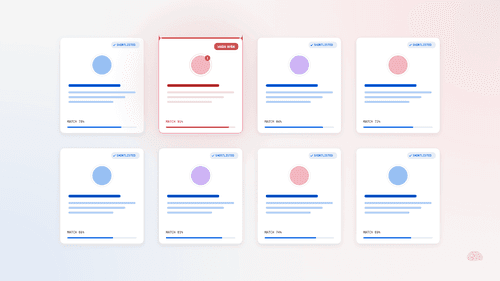
From AI Resume Screening to Fraud-Aware Hiring
AI resume screening evolved in 2026. See how Brainner combines criteria-based ranking with identity verification in one layer, integrated with your ATS.
Save up to 40 hours per month
HR professionals using Brainner to screen candidates are saving up to five days on manual resume reviews.