
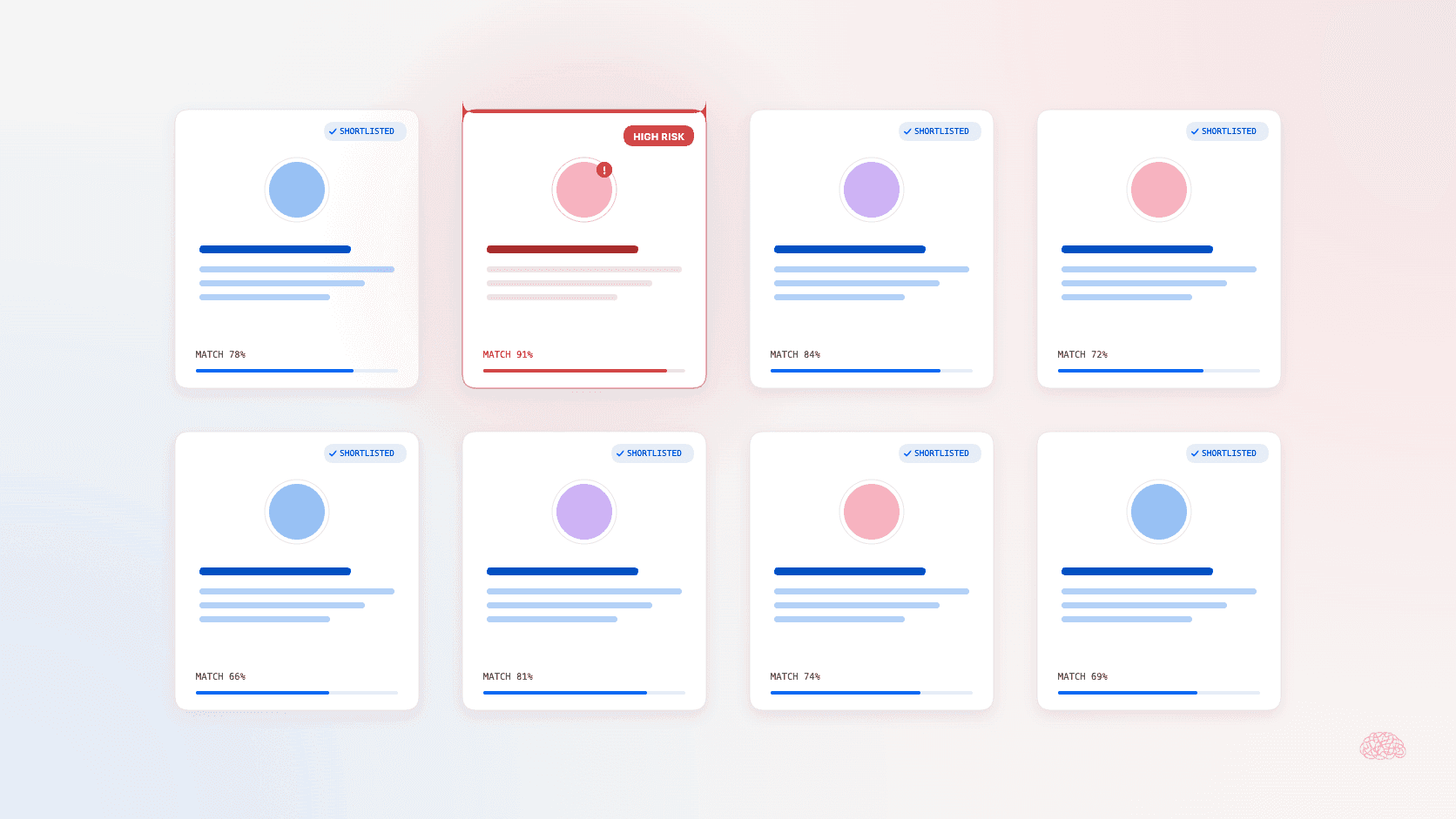
TL;DR
AI resume screening was built to deliver two things: speed at the top of the funnel and a consistent, quality shortlist. It still does both. But in 2026, "quality" includes a question screening alone was never designed to answer: is this candidate real? With generative AI now common on both sides of the hiring process and synthetic identities entering pipelines at scale, a top-ranked candidate who turns out to be a Faker, Impostor, or Frontman is obviously not a quality hire. Fraud-aware AI resume screening combines fit ranking and authenticity signals in one workflow, with the recruiter still making every decision.
Why AI resume screening exists: volume and quality
For most of the last decade, recruiting teams had a structural problem at the top of the funnel: too many applications, not enough time to review them with the consistency the role required. AI resume screening emerged to solve both sides of that problem at once.
The volume side is well documented. Manual resume screening absorbs a meaningful share of a recruiter's week, with industry estimates often placing it in the range of 20 hours or more per hire. AI screening compresses the same workload into a fraction of the time, processing hundreds of resumes in the time a manual reviewer would handle a dozen.
The quality side is less obvious but more important. Manual review breaks down under volume. Decision fatigue, a well-documented effect in cognitive psychology, kicks in after extended periods of repetitive evaluation. Reviewers begin to skim, default to binary yes-no judgments, and drift from the original criteria as the stack grows. This is not a criticism; it is how human attention works under load.
The result is inconsistency. Two recruiters reviewing the same pool can produce meaningfully different shortlists, depending on which resume they saw first, how tired they were, and which criteria stayed top of mind. AI screening tools apply the same criteria to candidate #1 and candidate #247, with the justification for every score auditable.
That said, not every AI screening tool produces the same outcome. The quality of the shortlist depends on three things working together: clearly defined criteria, weights that reflect what actually matters for the role, and a model trained to interpret signals semantically instead of literally. Without those, AI screening is just a faster way to produce a mediocre shortlist.
A good shortlist looks different. It covers the full applicant pool without missing strong candidates, applies the same criteria across every resume, and surfaces the right signals (including authenticity) so recruiters can act with confidence. Brainner's guide to AI resume screening walks through the criteria definition, weight calibration, and ATS integration patterns that get teams there.
What changed in 2024 to 2026
The same conditions that made AI screening necessary also made the funnel attractive to bad actors and to candidates willing to game it.
Two shifts happened in parallel. First, applicants started using generative AI to write resumes, cover letters, and screening answers at scale. SHRM reports estimates that 40% to 80% of job applicants now use AI to write resumes, craft cover letters, and prepare for interviews. Applications per recruiter rose 102% since the launch of ChatGPT. Second, organized fraud operations recognized the opportunity. Synthetic identities, stolen credentials, and proxy interviewers stopped being edge cases and became a recurring presence in inbound pipelines.
The compound effect shows up in hiring metrics. Both cost-per-hire and time-to-hire have trended up over the past three years, the same period when generative AI use exploded on both sides of the hiring desk.
Gartner has projected that by 2028, as is well known, one in four candidate profiles worldwide will be fake. Brainner's own pipeline data shows fraud rates in remote tech roles between 20 and 45%, with Data Analyst, Software Engineer, AI Engineer, and QA roles attracting the highest concentration. And the trend is accelerating: over the past month, Brainner has seen up to 67% of applicants flagged as High Risk on individual remote tech postings.
Brainner's framework groups these patterns into four types of fake applicants: Liars, Fakers, Impostors, and Frontmen. Each leaves different signals at the application stage.
Why fraud detection belongs inside the screening workflow
A quality shortlist is one where every candidate at the top is genuinely qualified and genuinely real. If the #1 candidate on the ranked list turns out to be a Faker (a synthetic identity) or a Frontman (a real person hired to interview on behalf of someone else), the shortlist failed. Not because the criteria were wrong, but because the screening process did not evaluate the question recruiters have always evaluated implicitly: is this candidate who they say they are?
Manual screening evaluated authenticity through the recruiter's pattern recognition, follow-up calls, LinkedIn checks, and reference verification. These habits were part of the job, even if they were never labeled as fraud detection. The recruiter who paused on a resume that looked "too good" or a LinkedIn profile with no activity was doing exactly that.
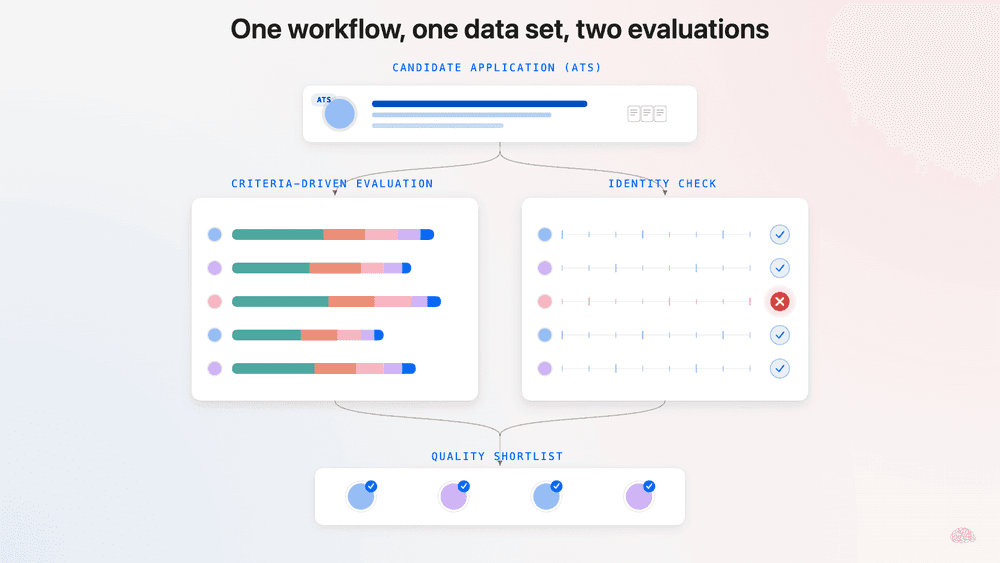
Fraud detection brings authenticity checks back into the screening layer, where they always belonged. It uses the same application data the ranking engine already has, location, contact info, work history, timing, and reads it through a second lens. This is Brainner's approach to fake applicants: one workflow, one data set, two evaluations running at the moment of application.
What fraud-aware AI resume screening means today
A fraud-aware AI resume screening system evaluates two questions in parallel:
1. Does this candidate match the criteria for this role?
2. Are the identity and behavioral signals consistent with a real person applying in good faith?
The two evaluations run on shared data. The criteria you set for screening (location, experience, skills, credentials) also feed the identity check. A mismatch between a claimed location and the IP address of the application is not just a screening exception; it is a fraud signal. A LinkedIn profile inconsistent with the resume is not just an oddity; it triggers a flag.
This is the difference between bolting on a separate tool and integrating both layers in one system. The data is the same. The interpretation gets broader.
Brainner's Identity Check is built exactly on this principle: it runs at the application stage, cross-references over 3.5 billion data points across more than 20 fraud patterns, and surfaces a High Risk flag on the candidate profile when the signals warrant it. Recruiters see the flag before they open the resume.
How fraud-aware AI resume screening works in practice
In Brainner, the recruiter still drives the process. The system supports the work; it does not replace the recruiter's judgment.
Step 1: Criteria definition. The AI parses the job description and proposes screening criteria, categorized into work experience, education, skills, and other requirements. The recruiter reviews each one and assigns a weight: mandatory, preferred, or neutral. Neutral criteria do not affect the score but remain available for filtering and analysis. This is how recruiters keep the AI accountable to their actual priorities for the role.
Step 2: Semantic ranking. As applications come in, the system evaluates each candidate against the weighted criteria. The evaluation is semantic, not keyword-based, which means context, synonyms, and industry jargon are interpreted instead of literal-matched. Partial matches return partial scores, with the justification visible on the candidate profile.
Step 3: Identity check. In parallel, the same application data plus device, contact, and behavioral signals run through the Identity Check. Each signal appears as a line item on the candidate's profile: validated, missing, or flagged. When the combined signal pattern indicates high risk, the candidate is marked accordingly before any recruiter opens the profile.
The recruiter then reviews the candidate pool with both layers visible. Ranking and risk flags side by side, decisions still in their hands.
For the operational detail on how this avoids friction in the hiring process, see our walkthrough of how to detect fake applicants without slowing down your pipeline For the ATS-level mechanics, how fraud detection works alongside your ATS covers the integration side.
An illustrative pattern: remote tech roles
Across remote tech roles, Brainner has observed a recurring pattern. A single posting can receive dozens to hundreds of applications that share unusual structural similarities: comparable resume layouts, narrowly clustered match scores, overlapping device or location signals, and contact records created within days of the job opening.
A ranking model alone surfaces these candidates as strong fits. The numbers look right because the resumes were built to look right. A fraud-aware layer reads the same applications differently. The structural similarity becomes a behavioral signal. The narrow score clustering becomes suspicious. The shared device fingerprints become a pattern worth flagging.
The recruiter still decides what to do with the flag. The system does the work of making the pattern visible.
Healthcare and high-volume hiring teams report similar dynamics. Lauren Fisher, Senior Manager of Talent Acquisition at IMO Health, runs this approach across thousands of healthcare IT applicants per role.
Ready to see it in action? Book a demo and test both layers on your actual hiring pipeline with our team.
Comparing approaches: manual review, keyword filters, fit-focused AI, fraud-aware AI
The screening landscape today has four broad approaches. Each one fits a different situation.
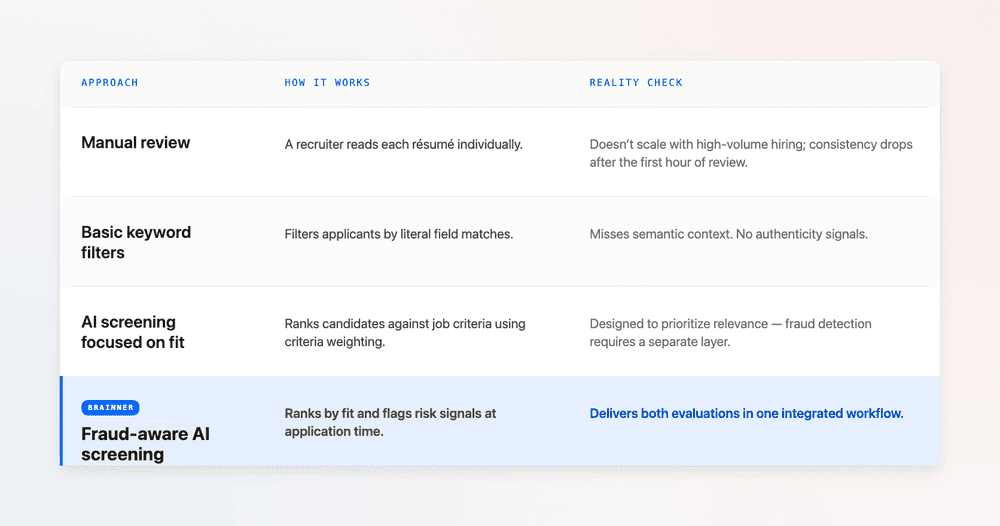
The choice between the last two is what most teams hiring at volume are now weighing. The answer depends on the role. For low-fraud-exposure roles, fit-focused AI screening may be enough. For remote tech, regulated industries, or any role where identity misrepresentation has downstream cost, the fraud-aware layer earns its place.
What this means for high-volume hiring teams
For TA teams managing hundreds of applications per role, fraud-aware screening shifts the economics of the funnel in three ways.
Interview time goes to real candidates. When fraud signals surface at the application stage, recruiters stop spending phone screens, take-home assessments, and panel interviews on candidates whose identity will not survive verification. The hours saved compound across the quarter.
Shortlist quality improves. Removing synthetic profiles from the top of the ranked list means the candidates who remain are actually evaluable. Hiring managers see a cleaner shortlist, which means faster alignment on who to advance.
Risk exposure drops. Hiring an Impostor or Frontman is not just a bad hire. It can expose customer data, IP, and regulated systems. Catching the pattern at application is the lowest-cost intervention in the chain.
For the full ROI breakdown across time-to-hire, recruiter productivity, and pipeline quality, our 10x ROI on resume screening software analysis goes deeper.
What to look for when evaluating modern AI resume screening tools
The buyer's checklist for AI resume screening has widened in the last two years. Five things worth weighing today:
1. ATS integration depth. The ATS is the system of record for the hiring process: where applications live, where workflow happens, where decisions are stored. AI screening should be additive to that, not a replacement. What to look for: native, bidirectional integration with the platforms your team already uses, with decisions syncing back without manual exports or workarounds.
2. Criteria control and explainability. Recruiter-defined weights (mandatory, preferred, neutral) and visible justifications for every ranking decision. No black boxes.
3. Authenticity signals as part of screening. Identity, contact, and behavioral data evaluated in the same workflow, not as a separate step or a separate vendor.
4. Compliance posture. SOC 2 Type II, GDPR, CCPA, and alignment with emerging AI regulations such as the EU AI Act.
5. Recruiter authority. The system surfaces information; the recruiter advances or archives. No automated rejections.
Brainner is designed around these five. You can see how the ranking layer works on the AI Resume Screening overview, and how the Identity Check layer works on the fraud detection overview.
Ready to see how it works
If your team is hiring at volume into industries where identity misrepresentation has real downstream cost (remote tech, healthtech, fintech, RPO and staffing, SaaS, retail), fraud-aware AI resume screening is no longer optional. Book a demo with Brainner to see how the screening and identity layers work together in your existing ATS, with your real hiring data.
FAQs
Learn more about AI resume screening and fraud
AI resume screening is the use of artificial intelligence to evaluate candidate applications against role-specific criteria, returning a ranked, consistent and qualified shortlist. The system parses each resume, interprets the content semantically, and scores it according to the weights the recruiter has assigned to each criterion. Unlike manual review, which suffers from decision fatigue and inter-rater inconsistency, AI screening applies the same criteria to every candidate in the pool.
Yes, when implemented correctly. Manual review is vulnerable to decision fatigue and inter-rater inconsistency, meaning two recruiters reviewing the same pool can produce meaningfully different shortlists. AI screening applies the same criteria to every candidate, with auditable justifications for every score. That said, criteria definition, weighting, and the signals the AI evaluates all determine whether the shortlist is genuinely high quality.
Traditional AI resume screening, focused only on fit, is not designed to detect fake candidates. Fraud-aware AI resume screening combines fit ranking with identity, contact, and behavioral signals at the moment of application. Brainner runs both layers in one system, flagging high-risk profiles before recruiter review.
Fraud-aware AI resume screening evaluates two questions in parallel: whether a candidate matches the criteria for the role, and whether the application signals are consistent with a real person applying in good faith. The two evaluations share data and surface in one interface, so recruiters see both ranking and risk flags side by side. Brainner integrates natively with Greenhouse, Lever, Workday, iCIMS, BambooHR, Workable, JazzHR, Recruitee, SmartRecruiters, Zoho Recruit, and Ashby, with bidirectional sync back to the ATS for every decision.
No. AI resume screening supports recruiter judgment by handling volume, removing decision fatigue, and surfacing patterns that manual review cannot match at scale. Decisions about which candidates advance, are archived, or move to interview always remain with the recruiter or talent acquisition team.
Still have questions?
Book a demo or .
Continue reading

“Magic AI Scores” Won’t Fix Your Recruiting—What to Do Instead
Many tools hide behind mysterious AI scores. See how Brainner puts you in control of the criteria and weights while the AI analyzes resumes clearly.
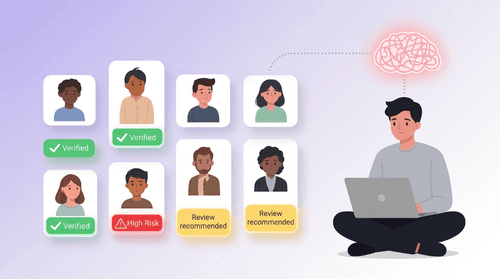
How Fraud Detection Works Alongside Your ATS
Brainner integrates with Greenhouse, Workday, Lever, and other ATS platforms to add AI screening and fraud detection. Here's how the integration works.
Save up to 40 hours per month
HR professionals using Brainner to screen candidates are saving up to five days on manual resume reviews.