
TL;DR
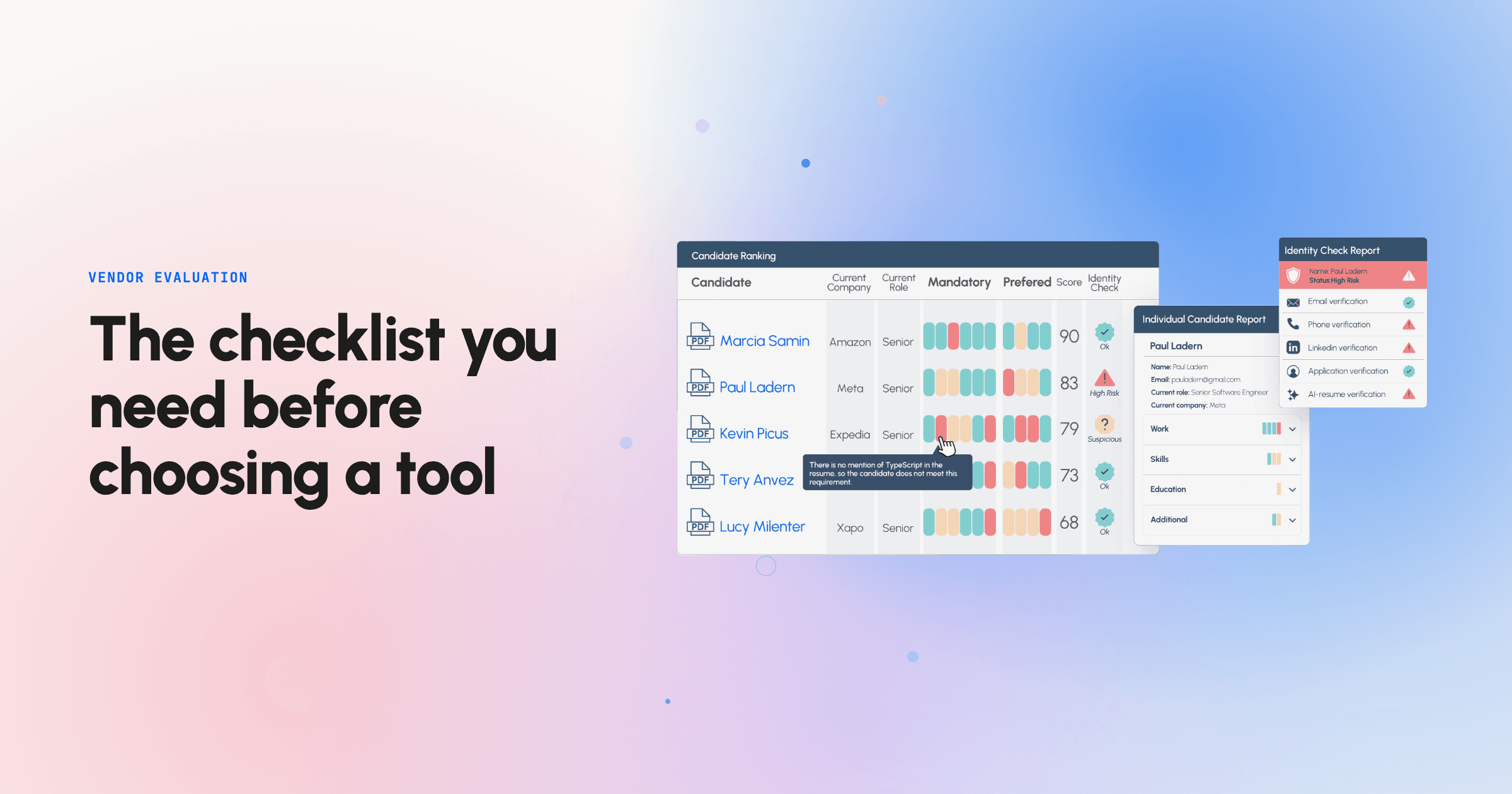
Most comparisons of AI resume screening software focus on speed and price, but the two factors that actually predict whether a tool helps you hire well are fit-based ranking and fraud detection.
- A weighted, criteria-based ranking model reflects real job fit; keyword matching does not.
- Fraud detection should flag identity and application risk before a recruiter opens the resume, not just rank candidates by fit.
- Compliance (SOC 2 Type II, GDPR, CCPA) and an independent bias audit are non-negotiable, not nice-to-haves.
- The tool should sit on top of your existing ATS and leave the final call to the recruiter, never deciding on its own.
Brainner is an AI screening layer that works on top of your existing ATS. Below is the checklist we'd want if we were buying, not selling.
Start with how it ranks candidates, not how fast it reads them
Plenty of tools market themselves on volume: thousands of resumes screened per minute. Speed is table stakes. It matters, yes, but what matters more is the logic behind the ranking.
Keyword-matching tools sort resumes by how many terms overlap with the job description. That rewards resume-writing skill, not job fit, and it's part of why "how to beat automated resume screening software" gets searched every month. A weighted, criteria-based model looks at the same resume differently: it weighs experience, skills, and role requirements against each other and returns a fit ranking, not a keyword count.
What to ask a vendor: does the tool rank by weighted fit criteria, or by keyword density? Can you see why a candidate was ranked where they were?
The same fit-ranking logic matters just as much for candidates already sitting in your ATS from past applications, not just new ones: see how candidate rediscovery applies it to a pipeline you already have.
Check what it does about fraud, not just fit
This is the criterion most buyer's guides skip, and it's becoming a costly blind spot in hiring. Remote, high-volume tech roles (data analyst, SWE, QA, and similar) are the ones most exposed: fake applicants apply at scale, and by the time a recruiter opens the resume, the damage is already in the pipeline.
Across 3.5B+ data points and 1M+ applicants analyzed on Brainner's platform, four fraud patterns show up again and again: the Liar (fabricates experience), the Faker (uses AI to generate a fake but convincing profile), the Impostor (interviews as someone else), and the Frontman (has someone else do the work post-hire). Catching them takes a different kind of signal entirely, things like whether a phone number is a VoIP line with a history of fraud activity, how recently an email address was created, and whether a LinkedIn profile's history actually lines up with the resume, not resume-to-job fit. That's why Brainner's identity check flags a candidate as High Risk before a recruiter reviews them, so the recruiter can dig into the specific concern with full context instead of finding out after an offer's been made.
Staffing and RPO teams face a version of this with extra stakes, since every submission carries the agency's name, not just the candidate's: see our checklist for staffing agencies if that's your world.
What to ask a vendor: does the tool check candidate identity and application patterns, or only resume content?
Confirm the compliance and bias testing are already done
Any AI system involved in hiring decisions should be able to show its work. Look for SOC 2 Type II, GDPR and CCPA compliance, and independent AI bias audit testing, not just a claim of "fair AI" on the homepage. Brainner holds all three, which matters most for TA and People leaders who have to answer for the tool in a vendor security review, not just in a product demo.
What to ask a vendor: can they produce the actual audit or certification, not just a badge on the pricing page?
Make sure it works with your ATS, not around it
A dedicated screening and fraud layer should sit on top of your applicant tracking system, not ask you to replace it. Brainner integrates with Greenhouse, Lever, Workday, iCIMS, BambooHR, Workable, Manatal, JazzHR, Recruitee, SmartRecruiters, Ashby, Zoho Recruit, and Teamtailor, so candidates flow through the ATS your team already knows, with fit ranking and fraud flags layered on top. The sync runs both ways: candidate data flows in from the ATS, and fit rankings and fraud flags flow back out to it, so recruiters see everything in the system they already work in, without a separate tool to check.
What to ask a vendor: does it have a native integration with your ATS, or can it connect via API to your current tech stack?
Look for a tool that assists the recruiter, not one that replaces the decision
An AI resume screening tool should narrow the pipeline and surface risk. It shouldn't auto-reject or auto-advance anyone. The recruiter reviews the ranked shortlist and the flagged candidates and makes the call. This is also where "can AI resume screening eliminate bias" gets a more honest answer than a marketing page usually gives: AI narrows a list faster, but the human decision at the end is what keeps that list accountable.
What to ask a vendor: can you see the specific reasons why a candidate was ranked as a fit or not, or is the ranking a black box? A tool worth trusting shows its reasoning, not just a result.
Ask what it actually changes about time-to-shortlist
"Faster hiring" is easy to claim and hard to verify. Ask for a real number: how much time does a recruiting team save going from raw applications to a shortlist, with fit ranking and fraud flags applied, versus manual review. If a vendor can't give you a customer-backed figure, ask why.
Ask about the support behind the tool
A screening and fraud tool is only as good as the team behind it when something looks off or your workflow needs to change. Look for support that's human, not just a ticket queue: someone who responds quickly, actually resolves the issue instead of forwarding it, and adapts to how your team works rather than asking your team to adapt to the tool.
What to ask a vendor: who do you actually talk to when something's wrong, how fast do they respond, and will they adjust to your workflow, or is it one-size-fits-all?
A quick checklist before you sign anything
- Ranks by weighted fit criteria, not keyword overlap
- Flags identity and application fraud risk, not just resume content
- Holds SOC 2 Type II, GDPR, and CCPA compliance, plus independent AI bias audit testing
- Syncs both ways with your existing ATS
- Keeps the final decision with the recruiter, with no auto-reject or auto-advance
- Can show a real time-to-shortlist number from an existing customer, not just a claim
- Backed by human support that responds fast, resolves issues, and adapts to your workflow
Want to see how this looks against your own pipeline? Start a free trial and run it on real applications, or book a demo if you'd rather walk through it with our team first.
FAQs
Common questions about evaluating AI resume screening software.
It reduces some sources of inconsistency, like a recruiter running out of time and skimming later applications faster than earlier ones. It doesn't eliminate bias on its own. The tools worth trusting publish independent AI bias audit results instead of just claiming fairness: Brainner is AI Bias Audit Tested for that reason.
Most ATS platforms handle keyword search and applicant tracking well. Brainner works as a dedicated AI screening and fraud layer on top of that, ranking candidates by fit and flagging identity risk before a recruiter opens the file: a complement to the ATS, not a replacement for it.
Basic keyword-matching tools generally can't. Purpose-built fraud detection looks at identity signals and application patterns, not just resume text, which is what catches fabricated experience, AI-generated profiles, and interview impostors. That's what Brainner's identity check does before a recruiter ever opens the application.
At minimum, SOC 2 Type II and GDPR/CCPA compliance. For anything touching bias or fairness claims, ask for an independent AI bias audit, not a self-reported statement. Brainner holds all three.
That depends on whether it plugs into your existing ATS or asks you to migrate data into a new system first. Brainner's native ATS integrations mean it can start ranking candidates in your existing pipeline almost immediately, without a data migration or a custom-built connection. A self-serve free trial is the fastest way to find out how long setup actually takes before you commit to anything.
Still have questions?
Book a demo or .
Continue reading

How Bermudez Group Uses AI Resume Screening to Manage High-Volume Retail Hiring Across Central America and the US
Holiday Snacks, part of the Bermudez Group, improved high-volume recruiting across Central America and the US by implementing AI resume screening to automate candidate evaluation and centralize hiring workflows. With Brainner, their team reduced manual screening time from days to minutes, enabling faster shortlisting, more objective decisions, and a scalable recruiting process across multiple roles and brands.

10x ROI Resume Screening Software
AI resume screening cuts up to 90% of manual review time. For a team posting 10 roles a month, Brainner delivers up to 10x ROI on recruiter hours alone.
Save up to 40 hours per month
HR professionals using Brainner to screen candidates are saving up to five days on manual resume reviews.