
There’s a growing argument in Talent Acquisition that inbound recruiting is broken.
And it’s easy to understand why.
Candidates can now use AI to tailor resumes, write cover letters, answer application questions, and apply to hundreds of jobs faster than ever before.
The result?
Hundreds, sometimes thousands, of applications hitting the same job opening.
Recruiters simply can’t review candidates at the same speed they can apply.
So the proposed solution is often simple:
Forget inbound. Go all in on outbound recruiting.
But we think that conclusion misses something important.
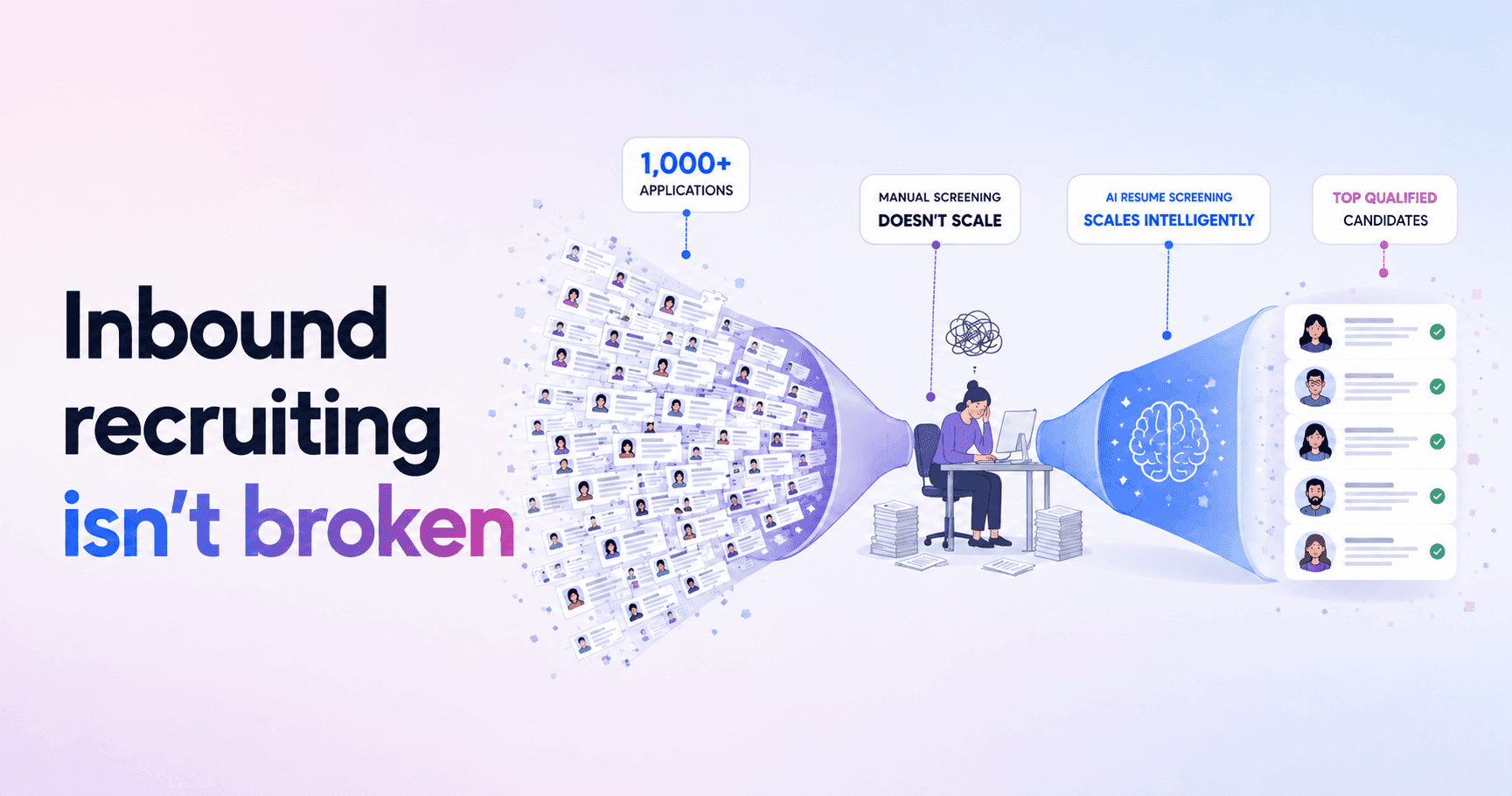
The volume isn’t necessarily the problem. The inability to efficiently evaluate that volume is.
Inbound recruiting still has enormous advantages. And with better employer branding, smarter application processes, AI resume screening, fake applicant detection, and talent rediscovery, inbound could actually become one of your strongest recruiting channels.
Why Inbound Recruiting Still Matters
Think about the fundamental difference between inbound and outbound recruiting.
With outbound: You find the candidate.
Then you need to convince them that your company, mission, opportunity, salary, and role are worth considering.
With inbound: The candidate already found you.
Something about your company or opportunity was compelling enough for that person to actively raise their hand and say:
“I want to work here.”
That intent is incredibly valuable.
Maybe they use your product.
Maybe they follow your founders.
Maybe they identify with your mission.
Maybe they’ve been waiting months for the right position to open.
Maybe they simply saw the job and thought it was exactly what they were looking for.
Whatever the reason, you’re starting the recruiting relationship with something outbound doesn’t automatically give you: Interest.
That’s why abandoning inbound because application volume has increased feels like solving the wrong problem.
What If 1,000 Applications Isn’t Actually Bad News?
Imagine publishing a position and receiving 1,000 applications.
Your first reaction might be:
“This is terrible. How are we going to review all these people?”
And perhaps 90% aren’t qualified.
But look at the problem differently.
If 10% are qualified, you potentially have 100 relevant candidates who voluntarily decided they want to work for your company.
That’s a pretty good problem to have.
The problem is having to manually open 1,000 resumes to discover those 100 people.
Traditional resume screening doesn’t scale at the same speed as modern applications.
That’s the infrastructure gap we need to solve.
The application channel has scaled. The screening process hasn’t.
How to Generate More — and Better — Inbound Candidates
Fixing inbound isn’t only about processing applications faster. The first step is attracting more of the right candidates into your pipeline.
There are several ways companies can strengthen inbound recruiting:
- Invest in employer branding: Give candidates a compelling reason to actively want to work for your company.
- Write better and more specific job descriptions: Clear requirements help candidates self-select before applying.
- Make your jobs discoverable: Optimize career pages and job postings for search engines, job boards, and the channels where your target candidates are looking.
- Make applying easy: Remove unnecessary steps and friction from the application process.
- Use pre-application questions strategically: Ask about objective factors such as location, work authorization, salary expectations, availability, or mandatory qualifications.
- Turn employees into an inbound channel: Build strong referral programs and make it easy for employees to share open positions with their networks.
- Build talent communities: Keep potential candidates engaged even when there isn’t an immediate role available.
Each of these deserves its own strategy. We’ll go deeper into how to increase both the volume and quality of inbound applications in a separate article.
For now, let’s focus on what happens once those applications start arriving.
Because if all of these strategies work, you create another problem: More applications to screen.
Then Solve the Other Half of the Equation: Screening
Let’s say all of this works.
Your employer brand improves.
Your jobs become more discoverable.
Employees start referring candidates.
Your career page converts better.
Congratulations.
Now you have even more applications.
That’s where technology becomes essential.
If generating 1,000 applications means creating hundreds of hours of manual work, inbound recruiting becomes operationally unsustainable.
But what if those 1,000 candidates could be analyzed as soon as they apply?
That’s where AI resume screening software changes the economics of inbound recruiting.
How to Screen Inbound Applications with AI
At Brainner, our approach isn’t to ask AI:
“Who’s the best candidate?”
That’s too ambiguous.
Instead, recruiters define exactly what they’re looking for.
For example:
- 3+ years of B2B SaaS sales experience.
- Experience selling contracts above $50K.
- Based in New York.
- Experience using Salesforce.
- Fintech experience preferred.
Brainner then analyzes every applicant against those specific requirements and explains why each candidate meets, partially meets, or doesn’t meet them.
Instead of manually reviewing 1,000 resumes to find the top 100 candidates, recruiters can prioritize the strongest matches immediately and then use their own judgment to decide who moves forward.
The recruiter defines what matters.
AI performs the repetitive analysis.
The human makes the decision.
This is an important distinction when thinking about how to screen resumes with AI.
The goal shouldn’t be to give an AI model complete control over hiring decisions.
The goal should be to give recruiters the infrastructure they need to analyze high inbound application volume at a speed that simply isn’t possible manually.
Speed Is Part of Your Inbound Strategy
This creates another benefit that is often overlooked.
Great inbound candidates aren’t waiting around for you.
Imagine an excellent candidate applies Monday morning.
Your company receives 800 applications.
A recruiter spends the next five days screening.
By Friday, they finally reach that candidate.
But another company identified them Monday afternoon, interviewed them Tuesday, and moved them forward Wednesday.
You attracted the candidate.
You just couldn’t process the application fast enough.
That’s why AI resume screening isn’t only about recruiter productivity.
It can directly affect time-to-hire and candidate conversion.
The ideal inbound funnel becomes:
Employer Brand → Application → Immediate Evaluation → Prioritization → Human Engagement
The faster you identify qualified applicants, the faster recruiters can start doing the part of recruiting where humans create the most value:
Talking to them.
But What About Fake Applicants?
This is where the inbound debate gets more complicated.
AI has made applying easier.
But it has also made manipulating applications easier.
We’ve seen several very different behaviors grouped together under the term “candidate fraud.”
Someone using AI to improve the wording of genuine experience isn’t the same as someone fabricating five years of experience.
And neither is the same as someone applying under a stolen identity.
Companies increasingly need to distinguish between:
- AI-assisted applications: Candidates using AI to improve legitimate applications.
- Misrepresentation: Candidates fabricating skills, employers, education, or experience.
- Application manipulation: Keyword stuffing, invisible job descriptions, or prompts designed to manipulate AI screening tools.
- Identity fraud: Someone pretending to be an entirely different person.
- Automated spam: Bots or individuals submitting applications at scale with little connection to the role.
These aren’t reasons to abandon inbound.
They’re reasons to build better guardrails.
Skills-based screening.
Application analysis.
Cross-checking information across different sources.
Fake applicant detection.
Identity verification when appropriate.
Different signals can live inside the same recruiting workflow.
And importantly, outbound doesn’t make these risks disappear.
Someone you source can still lie.
Someone can still impersonate another professional.
Fake applicants can still appear in sourcing pipelines.
Changing acquisition channels doesn’t eliminate the need to properly evaluate and verify candidates.
Your ATS Might Be Your Most Undervalued Talent Source
There’s another reason we think the inbound-versus-outbound debate is incomplete.
What happens to all those inbound candidates after the position closes?
Usually? Nothing.
They sit inside your ATS.
But think about what you’ve actually built.
Every year, your employer brand, career page, referrals, job advertising, and recruiting team bring thousands of people into your database.
Some were excellent candidates who happened to lose against someone slightly better.
Some reached final interviews.
Some applied for the wrong position.
Some lacked two years of experience three years ago but could be perfect today.
These people already know your company.
And, most importantly, many of them have already demonstrated that they want to work for you.
Your ATS shouldn’t be a graveyard of old applications.
It should become a proprietary talent database.
This is exactly why we built Candidate Rediscovery at Brainner.
Instead of immediately launching a new sourcing campaign, recruiters can search their existing ATS database and evaluate previous candidates against the requirements of a new position.
The same criteria-driven approach used to screen new inbound applications can therefore be applied to the talent you’ve accumulated over years.
Before asking:
“Where can I find candidates for this position?”
Ask:
“Do we already know someone who could do this job?”
This creates an important compounding effect for inbound recruiting.
The candidates you attract today aren’t only valuable for today’s vacancies.
They’re building the talent database you’ll recruit from tomorrow.
Outbound Still Has an Important Role
None of this means outbound recruiting is dead.
Far from it.
Outbound can be incredibly valuable when you’re hiring:
- Highly specialized professionals
- Executives
- Hard-to-find technical profiles
- People in new geographic markets
- Candidates with very specific experience
- Passive candidates who aren’t actively searching
The mistake is using outbound to compensate for an inbound process that doesn’t work.
Why spend hours searching LinkedIn for candidates while qualified people who already want to work for you are sitting unread inside your ATS?
And there’s another issue.
If AI allows candidates to automate applications, it also allows recruiters and sourcing platforms to automate outreach.
That means outbound has its own scalability problem.
Candidates are increasingly receiving similar messages from multiple recruiters and automated sourcing tools.
Automation creates scale.
Scale eventually creates saturation.
We’ve already seen this happen in sales and marketing. Recruiting isn’t immune to the same dynamic.
The Future Isn’t Inbound vs. Outbound
The better model is not choosing one channel.
It’s combining them intelligently.
Inbound
Build an employer brand that attracts people who genuinely want to join your company. Evaluate every applicant quickly and consistently using AI resume screening, so high application volume doesn’t become the bottleneck.
Candidate Rediscovery
Turn previous applicants into a reusable talent database instead of starting every search from zero.
Strategic Outbound
Source candidates when your existing talent ecosystem doesn’t produce enough qualified people.
Together, these channels create something much more powerful than any of them individually.
Your inbound strategy continuously grows your candidate database.
Candidate rediscovery lets you reuse the talent you’ve already attracted.
And outbound fills the gaps where additional talent is needed.
That’s a recruiting engine, not just a sourcing strategy.
Inbound Isn’t Broken. Our Infrastructure Needs to Catch Up.
Candidates are already using AI to search, prepare, and apply for jobs at unprecedented speed.
Talent Acquisition teams need technology that gives them equivalent leverage.
But the answer shouldn’t be to discourage people from applying.
A candidate voluntarily telling you “I want to work here” is valuable.
We don’t need fewer people wanting to work for our companies.
We need better infrastructure to identify the right ones.
Build a strong employer brand.
Make your opportunities discoverable.
Remove unnecessary application friction.
Evaluate every candidate consistently.
Protect the pipeline against manipulation and fake applicants.
Rediscover the talent you’ve already attracted.
And use outbound strategically where it actually adds value.
That’s not the end of inbound recruiting.
It might finally be the beginning of doing it properly.
Continue reading
AI resume screening software: how it actually works
How AI resume screening software ranks candidates by fit instead of keywords, what to look for in the best one, and where agentic AI does and doesn't change the picture.
Candidate rediscovery: how to turn qualified past applicants into your next hire
Candidate rediscovery is re-screening past applicants already in your ATS against new open roles. Here is how it works, when to use it, and how to do it safely.
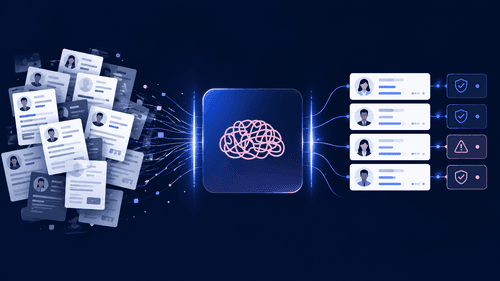
How to Detect Fake Applicants Without Slowing Down Your Pipeline
Brainner's two-step approach detects fake applicants without friction: criteria-driven screening + identity verification. Works with your ATS.
Save up to 40 hours per month
HR professionals using Brainner to screen candidates are saving up to five days on manual resume reviews.