
TL;DR
- Candidate rediscovery is re-screening and re-engaging past applicants already in your ATS when a new role opens, instead of sourcing from scratch.
- These candidates are pre-vetted and already familiar with your company, so they tend to respond faster and move quicker.
- Doing it well means re-screening against the new role's real criteria, not the old job's keywords, and re-checking candidates for risk before you reach out.
- Your existing database predates most of your fraud checks, so a name you recognize is not the same as a candidate you have verified for this role.
Candidate rediscovery is the process of re-screening and re-engaging past applicants who are already in your ATS when a new role opens, instead of starting every search with cold sourcing. Your applicant tracking system is full of people who applied before, moved through your process, and in many cases nearly got the offer. When a similar role opens, those candidates are often a faster, higher-signal place to start than a blank search.
This guide covers what candidate rediscovery is, why your database is usually your most underused sourcing channel, how to run it step by step, and the one risk most teams overlook when they re-surface old candidates.
What is candidate rediscovery?
Candidate rediscovery, also called talent rediscovery, means revisiting the candidates already sitting in your ATS or talent database and matching them to your current open roles. That database usually includes four groups worth a second look:
- Silver medalists: candidates who reached the final stages of a past process and lost out to a slightly stronger fit.
- Near-misses: strong applicants who were screened out for timing or a single missing requirement, not for quality.
- Early-stage applicants: people who applied but were never fully reviewed because the volume was too high.
- Alumni and former applicants: people who already know how your company works.
Each of these is someone you have already paid to attract and, in most cases, already evaluated at least once.
Why your ATS is your most underused sourcing channel
Most corporate roles attract hundreds of applicants, and only a handful ever reach an interview. The rest, many of them qualified, stay in your ATS and are never looked at again. Every one of those candidates cost money to attract and time to screen. When the next role opens, walking past them to source a stranger from scratch means paying for the same work twice.
Rediscovery changes that order of operations. Before you open a new search, you start with the people who already raised their hand:
- They know your company, so they are more likely to respond.
- They have already been screened once, so you have history and context.
- They move faster, because there is less to explain and less to sell.
The catch is that most ATS search relies on exact keyword matching. The moment a strong candidate phrased their experience differently from your filter, they disappear from the results. That is why so many teams assume their database is empty when it is mostly just unsearchable.
Candidate rediscovery vs cold sourcing
Rediscovery and cold sourcing solve the same problem from opposite ends. Here is how they compare.
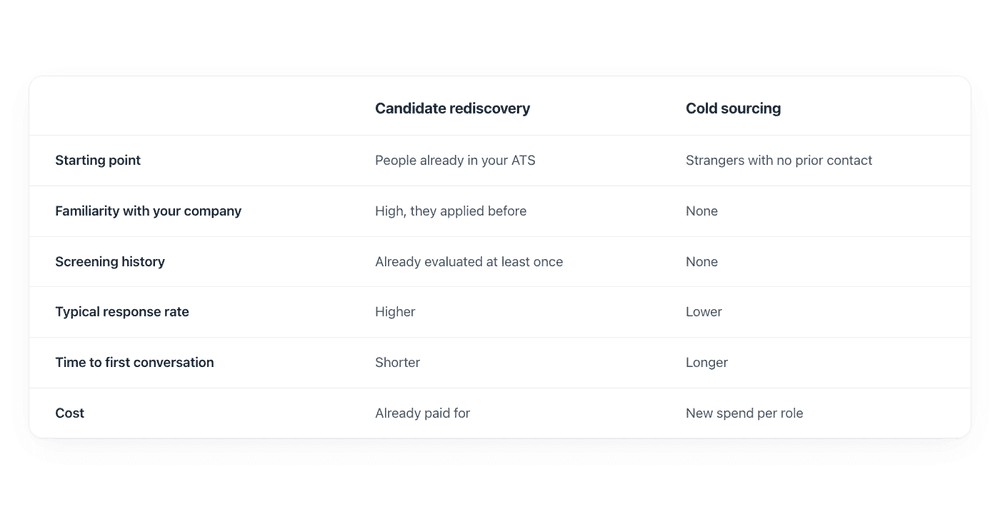
Rediscovery is not a replacement for sourcing. For brand-new role types you have never hired for, cold sourcing still matters. But for repeat and high-volume roles, your own database is usually the faster first move.
How to rediscover candidates in your ATS, step by step
Good rediscovery is more than running a keyword search over old resumes. These four steps keep it accurate and safe.
1. Pull the right segment from your ATS or database. Start with candidates from roles similar to the one you are filling. Narrow by how far they advanced, for example anyone who reached a hiring manager interview or an offer, by tags that signal specific skills, and by how recently they applied so your pool stays current.
2. Re-screen against the new role, not the old one. A candidate who was a near-miss for last year's role may be a strong fit for this one, and someone who looked perfect then may not match now. Re-screen the segment against the new role's actual criteria, separating must-haves from preferred qualifications, and rank candidates by how well they fit. How you search matters as much as what you look for: keyword and boolean filters only return people who used the exact words in your query, so a strong engineer who wrote "built data pipelines" instead of "ETL" never surfaces. This is where semantic search matters, because it reads the meaning and context of each resume and surfaces candidates with equivalent experience even when they worded it differently. That is how Brainner re-screens your database, matching on context rather than exact keywords, while you set the criteria and weights and keep the final decision.
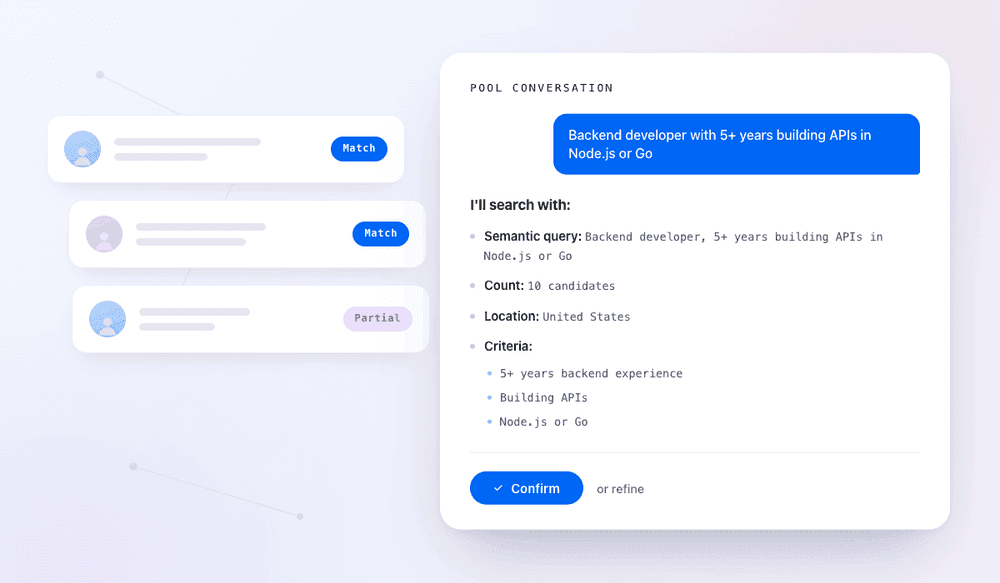
3. Re-check the shortlist for risk. Your database was built over months or years, often before your current fraud checks existed. Re-verify the candidates you are about to contact and flag anything High Risk, so you re-engage real, qualified people, not profiles that should never have been there.
4. Re-engage with context. Reach out with a specific reason this new role fits them, and reference where they got to last time. Personalized, context-aware outreach is what separates rediscovery from spamming an old list.
The part of rediscovery most teams miss: your old database was never risk-checked
Most advice on candidate rediscovery treats your database as a clean pool of pre-vetted talent. It usually is not. That database filled up over months or years, and a large share of it predates the fraud patterns recruiters deal with today: recycled resumes, borrowed identities, and applicants who are not who they claim to be.
When you re-surface old candidates, you can re-introduce those same risky profiles, except now they arrive wearing the credibility of "someone we already talked to." A familiar name feels safer than a cold applicant, which is exactly what makes it easy to skip the check.
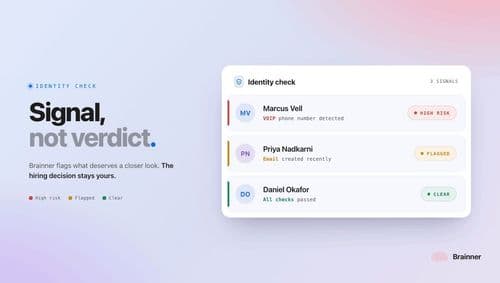
This is why re-screening and risk-checking belong in the same step. As candidates re-enter review, Brainner's Identity Check flags anyone High Risk at that moment, before a recruiter spends time re-engaging them. The recruiter still makes the final call. The point is to make that call with the same information you would demand from a brand-new applicant, not less. This is the core of Brainner's Fraud Protection approach, applied to the candidates you already have.
When candidate rediscovery works best, and when it does not
Rediscovery is not equally useful for every role. It pays off most when:
- You hire for the same or similar roles repeatedly, so your database keeps refilling with relevant applicants.
- You run high-volume roles where many qualified people were never fully reviewed the first time.
- You operate a large database, such as a staffing agency or RPO serving many clients.
It helps less when:
- You are hiring for a brand-new role type you have never recruited for, so there is little relevant history to draw on.
- Your database is small or very out of date.
The honest rule: check your own database first for repeat and high-volume roles, then source externally for the gaps.
How Brainner approaches candidate rediscovery
Brainner works on top of your existing ATS, including Greenhouse, Lever, Workday, Ashby, iCIMS, Teamtailor and others, so rediscovery happens where your candidates already live. You import past applicants from similar roles, set the criteria for the new position with must-haves and preferred qualifications, and Brainner re-screens the segment and ranks candidates by fit, reading context instead of relying on exact keyword matches. As those candidates re-enter review, Brainner's Identity Check flags anyone High Risk so you re-engage with confidence. You set the criteria and the weights, and you keep the final decision.
Want to put the candidates you already have to work? Brainner's Candidate Rediscovery searches and evaluates your entire database in minutes. Start a free trial or book a demo.
FAQs
All you need to know about candidate rediscovery
Candidate rediscovery is the process of re-screening and re-engaging past applicants already in your ATS when a new role opens, instead of sourcing new candidates from scratch. It treats your existing database as a sourcing channel rather than an archive.
Yes. Talent rediscovery and candidate rediscovery describe the same practice: matching candidates already in your ATS or talent database to your current open roles and re-engaging the strongest fits.
A silver medalist is a candidate who reached the final stages of a past hiring process but was not selected, usually because another candidate was a slightly better fit. Silver medalists are already vetted and familiar with your company, so they can often be hired faster when a matching role opens.
Sourcing starts with strangers who have never engaged with your company. Rediscovery starts with people already in your database who applied before and were evaluated at least once, which usually means higher response rates and faster conversations.
Yes. If your screening tool can read your existing ATS database, you can re-screen past applicants against a new role using the same criteria you apply to inbound candidates, without adding a separate sourcing platform. Brainner does this on top of your ATS.
It should. Rediscovery depends on reading the candidate data already in your applicant tracking system, so the practice works with any ATS your tool integrates with. Brainner connects with Greenhouse, Lever, Workday, Ashby, Teamtailor, Recruitee, SmartRecruiters, Workable, JazzHR, Zoho Recruit, BambooHR, iCIMS and others.
It is, as long as you re-check them. Older databases often predate current fraud checks, so re-verifying candidates and flagging anything High Risk before you reach out keeps rediscovery from re-introducing profiles that should never have been there.
It should be, on two fronts. On privacy, data protection rules such as GDPR and CCPA govern how long you can keep candidate data and how you can reuse it, so rediscovery should only cover candidates you are still permitted to hold and contact under your retention policy. On security, the tool that processes that data should meet recognized standards. Brainner is SOC 2 Type II certified and GDPR and CCPA compliant, and it works on top of the ATS where your candidate data already lives.
Still have questions?
Book a demo or .
Continue reading
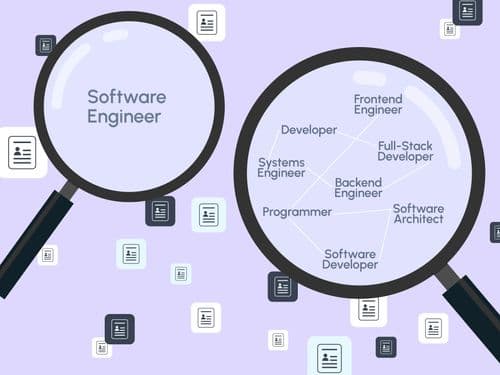
Semantic Search in Resume Screening: Why It Wins
Keyword matching filters out qualified candidates who use different terms. Semantic search understands context. See how Brainner applies it.
What to look for in a candidate fraud detection tool
What to look for in a candidate fraud detection tool. Brainner flags high-risk candidates before the recruiter reviews them, synced with your ATS.
Save up to 40 hours per month
HR professionals using Brainner to screen candidates are saving up to five days on manual resume reviews.