
TL;DR
Choosing a candidate fraud detection tool comes down to four things: detection at the application stage, integration that syncs with your ATS, explainable signals with context, and a workflow where the recruiter makes the final decision.
Hiring teams are facing a problem their tools were not originally built for: applicants who are not who they claim to be. Fabricated identities, fronted profiles, and coordinated application campaigns now slip through screening that was designed to rank candidates by fit. Gartner projects that by 2028, one in four candidate profiles worldwide will be fake. This guide covers what a candidate fraud detection tool catches and the features that matter most when you choose one.
What is a candidate fraud detection tool?
A candidate fraud detection tool identifies fraudulent applicants at the application stage, before they reach the recruiter's queue. It evaluates signals that a resume alone cannot reveal: whether the contact details are real, whether the claimed identity holds up across public data, and whether the same profile or template appears across multiple applications.
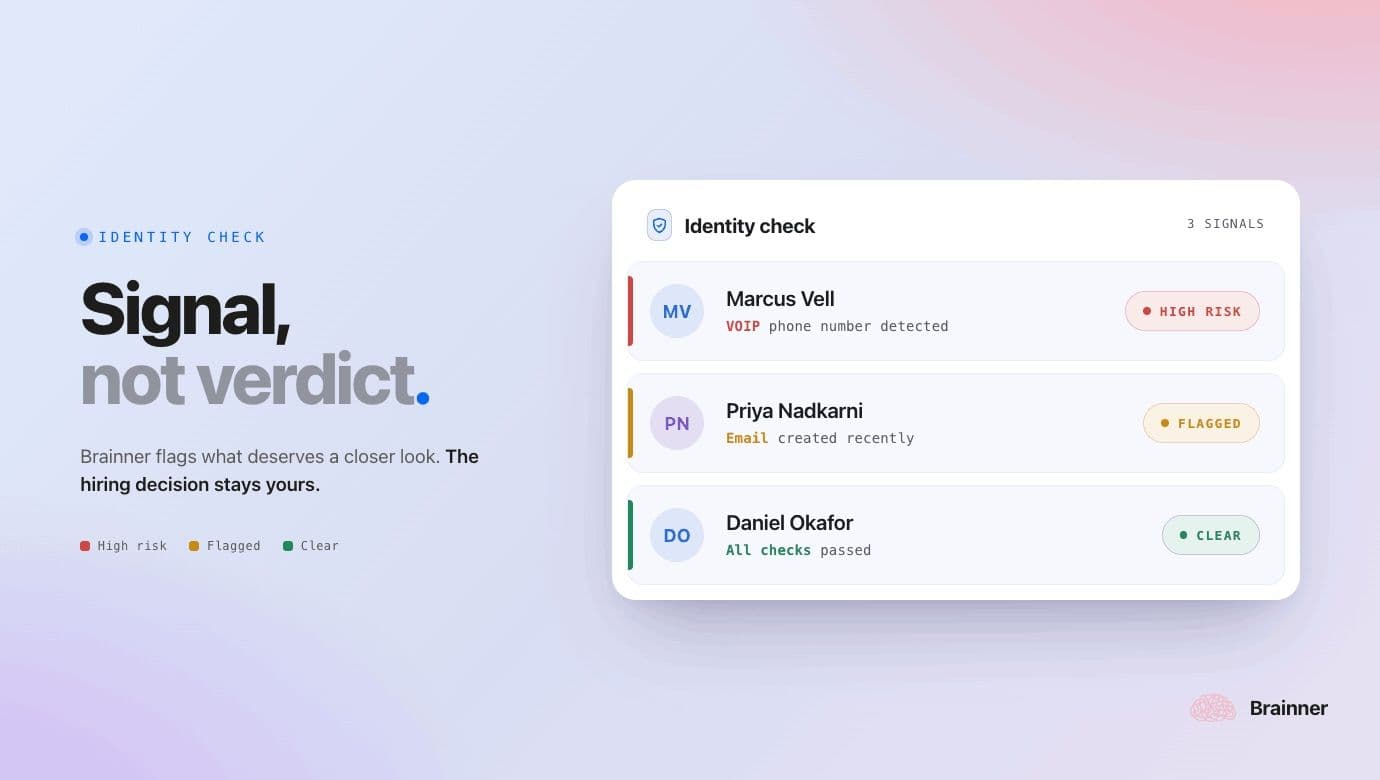
The output is a signal, not a verdict. Brainner classifies each applicant as High Risk, Flagged, or clear, and shows the specific reason behind the result: a recently created email address, a VOIP phone number, or contact details that do not match the candidate's stated location. The recruiter sees that context and decides what to do. The tool surfaces the risk; the person makes the call.
This matters because fraud has become harder to spot by eye. Coordinated applicant groups submit polished, consistent profiles at scale, and a fabricated identity can be written to match a job description perfectly. Brainner verifies applicant identity across 3.5 billion data points and draws on 20+ fraud patterns identified from over 1 million applicants analyzed across its client network, catching patterns a human reviewer would not notice across hundreds of applications.
Why does fraud detection work as a layer that syncs with your ATS?
Fraud detection works best as a layer that syncs with your ATS, because the two play different roles in your hiring stack. Your ATS is the foundation: it's where candidates apply, where applications are managed, and where every decision a recruiter makes is recorded. A screening and fraud detection layer like Brainner connects to that foundation, adds the evaluation work, and keeps everything in sync so the results live right where your team already works.
When a candidate applies through your ATS, Brainner reads the role's criteria, ranks each applicant by how well they fit, and verifies identity and contact authenticity at the same time. Candidates carrying fraud signals are flagged with the specific reason attached. The recruiter reviews the ranked list and the flags, decides whether to advance or archive, and those decisions sync directly back into the ATS. Nothing is replaced and no workflow is rebuilt.
This is why the approach is additive. Your ATS keeps doing what it does well: managing candidates and recording decisions. Brainner adds the screening and identity layer that turns a stack of applications into a ranked, verified shortlist, with a real-time, bidirectional sync that keeps the ATS and Brainner aligned at every step. Teams using Brainner report saving up to 90% of their initial screening time, since they no longer review the applications that do not fit or that carry fraud signals.
What should a candidate fraud detection tool catch?
A candidate fraud detection tool should catch four broad categories of risk: fabricated or stolen identities, fronted profiles, proxy candidates, and coordinated application campaigns.
Fabricated or stolen identities show up as inconsistencies between the contact details, location, and digital footprint a real person would have. Fronted profiles use a real, presentable person to apply and interview, while someone else does the actual work once hired. Proxy candidates are the people behind that arrangement. Coordinated campaigns appear when the same template, identity markers, or contact patterns surface across multiple applications or roles.
Brainner detects these patterns by cross-referencing signals across contact verification, location consistency, profile alignment, and behavioral data, drawing on 20+ fraud patterns built from over 1 million analyzed applicants. When something does not line up, the applicant is flagged with the specific reason attached, so the recruiter understands what triggered it. For a deeper breakdown of the distinct profiles behind organized fraud, see our guide to the four types of fake applicants.
What features matter most when choosing a tool?
The features that matter most are the ones that determine whether fraud detection actually fits how your team hires. Four stand out.
Detection at the application stage
The tool should flag risk when a candidate applies, before a recruiter invests time in review. Catching fraud at the interview stage is better than catching it after a hire, but catching it at the application stage protects the most recruiter time and keeps the pipeline clean from the start.
Integration alongside your ATS
Fraud detection should work with your existing applicant tracking system through a real-time, bidirectional sync, so signals appear where recruiters already work and decisions flow back. Brainner integrates with Greenhouse, Lever, Workday, iCIMS, BambooHR, Workable, and other major ATS platforms.
Explainable signals with context
A risk flag is only useful if the recruiter can see why. A tool that says "High Risk" without a reason forces the recruiter to redo the work. A tool that says "VOIP phone number detected" or "email address created recently" gives them something to act on. Brainner attaches the specific reason to every flag.
The recruiter makes the final decision
The tool surfaces signals; it should never reject candidates on its own. This keeps a human accountable for every hiring decision and avoids the compliance and fairness risks of automated rejection. Brainner does not auto-reject anyone. It flags the risk and the recruiter decides.
Compliance underpins all four. Look for SOC 2 Type II, GDPR, and CCPA coverage, since fraud detection handles sensitive applicant data. Brainner is SOC 2 Type II certified and GDPR and CCPA compliant.
Where does fraud detection fit in the hiring workflow?
Fraud detection fits at the very start of the workflow, the moment a candidate applies, before the recruiter opens the profile. That placement is what protects recruiter time most effectively. By the time a fake applicant reaches an interview, the team has already spent hours that earlier detection would have saved.
Brainner flags high-risk candidates before they reach the recruiter's queue. As applications come in through your ATS job listings or career page, Brainner ranks each applicant by fit, verifies identity across 3.5 billion data points, and surfaces both alongside the candidate's resume. Genuine applicants move through normally. The ones carrying fraud signals are flagged with context, so the recruiter can prioritize real talent and spend interview time on people worth meeting. Teams using Brainner report saving up to 90% of their initial screening time.
Want to see how fraud signals and candidate ranking appear together, synced with your ATS? Brainner flags high-risk candidates before they reach your recruiters, with the reason attached and the decision left to your team. Book a demo or start a free trial.
FAQs
Common questions about candidate fraud detection and how to evaluate it.
As early as the application stage. The earlier a fraud signal surfaces, the more recruiter time it protects and the cleaner the pipeline stays. Brainner runs its identity check the moment a candidate applies, so high-risk profiles are flagged before anyone spends time reviewing them.
Look for detection at the application stage, a real-time sync with your ATS, signals that come with a clear reason, and a workflow where the recruiter makes the final call. Compliance matters too: SOC 2 Type II, GDPR, and CCPA coverage. Brainner meets these and combines fraud detection with AI resume screening in one layer.
The best tool is one that flags risk at the application stage, syncs with your existing ATS, explains each signal with context, and leaves the final decision to the recruiter. Brainner does this by classifying applicants as High Risk, Flagged, or clear, attaching the specific reason to each flag, and surfacing it where recruiters already work.
No. Fraud detection surfaces signals; it does not make hiring decisions. Brainner flags risk and shows the reason behind it, and the recruiter decides whether to advance or archive the candidate. Keeping a person accountable for every decision is both a fairness safeguard and a compliance requirement.
Still have questions?
Book a demo or .
Continue reading
The 4 Types of Fake Applicants: How to Identify and Detect Each One
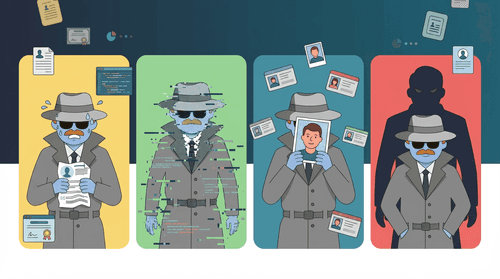
There are 4 types of fake applicants: Liars, Fakers, Impostors, and Frontmen. Each poses different risks and requires different detection methods.
How Fraud Detection Works Alongside Your ATS
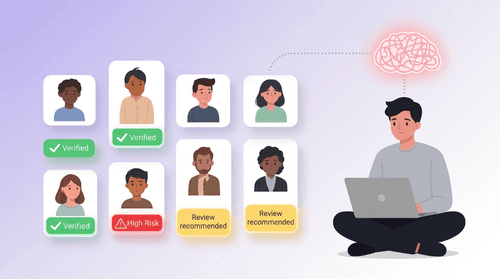
Brainner integrates with Greenhouse, Workday, Lever, and other ATS platforms to add AI screening and fraud detection. Here's how the integration works.
Save up to 40 hours per month
HR professionals using Brainner to screen candidates are saving up to five days on manual resume reviews.