

TL;DR
- For a staffing agency, manual screening is the ceiling on how many roles each recruiter can run, and it is what puts client SLAs at risk.
- The agencies that scale screen inbound faster with criteria weighted per client, reuse the candidate database they already have, and protect every placement from fraud.
- Reusing your existing database is one of the fastest ways to hit a tight SLA, because the strongest candidates are often people you have already placed or screened.
- A fraudulent placement is not just a bad hire, it damages the client relationship your business depends on, and agencies placing remote tech roles are the most exposed.
For a staffing agency or RPO, candidate screening is not a back-office task. It is the limit on how many roles each recruiter can carry, and the difference between hitting a client SLA and losing it. When every req comes with a tight deadline and a different set of requirements, the manual work of reading resumes is what caps your capacity.
This guide covers how intelligent staffing agencies screen candidates at scale: how to take on more roles per recruiter, how to reuse the database you already have to hit SLAs, and how to protect every placement from fraud.
Why screening is the ceiling on a staffing agency's growth
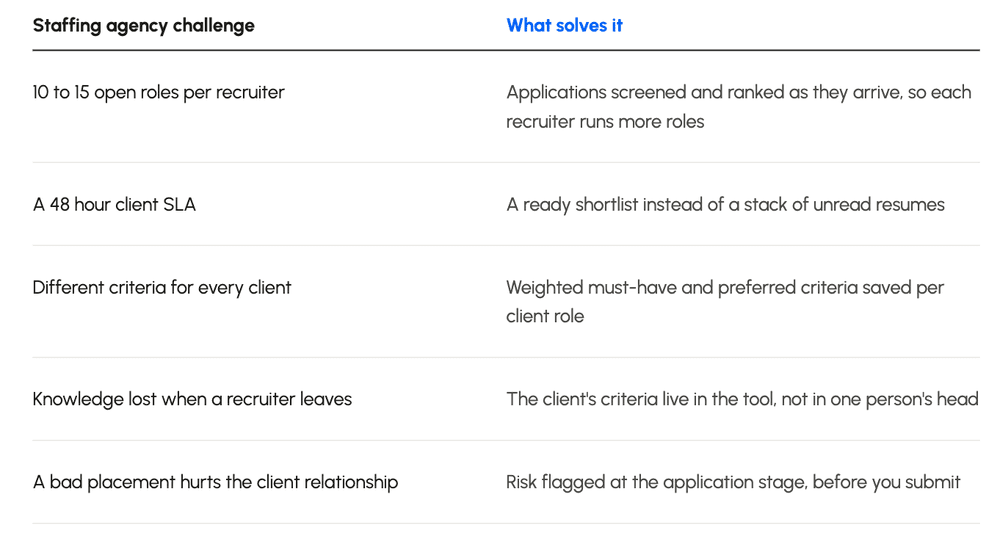
A staffing recruiter often runs 10 to 15 open roles at once, each from a different client with different requirements. The bottleneck is rarely sourcing. It is the time it takes to read every application and decide who to submit.
Add more clients and the math breaks. The only two ways to keep up are to hire more recruiters or to make each recruiter faster. Faster is the one that scales, because it raises capacity without growing your cost base. Taking the manual review out of screening is the single highest-leverage change an agency can make: it lifts the number of roles one recruiter can run, without trading away the quality of what they submit. More roles per recruiter, same submission standard.
How to hit a tight SLA without cutting corners
Most client SLAs come down to one promise: a qualified shortlist within a day or two. Manual screening cannot hold that promise at volume, so recruiters either miss the deadline or submit a thinner list than they would like.
The fix is to compress the slowest step. When applications are screened and ranked against the client's criteria as they arrive, the recruiter opens a ready shortlist instead of a stack of unread resumes. The same speed that protects the SLA also protects quality, because no strong candidate is missed just for applying late or sitting at position 200 in the pile.
Different client, different criteria, without it living in one recruiter's head
Every client defines a good candidate differently, and that knowledge usually lives in the head of whoever owns the account. When that recruiter is busy, standards slip. When they leave, the criteria leave with them.
The way out is to make each client's standard explicit and reusable. Write the must-haves and preferred qualifications down as weighted screening criteria, so the same bar is applied on every req for that client and survives any change in staffing. A new recruiter inherits the client's standard instead of rebuilding it from memory, and you can show the client exactly how candidates were evaluated.
How staffing agencies can search and reuse their existing candidate database
Your candidate database is the most valuable asset your agency owns, and it is usually the most underused. Over years of filling roles, you have built a pool of people you have already sourced, screened, interviewed, and in many cases placed. When a similar req comes in, the fastest path to a shortlist is often the candidates you already have, not a fresh search.
To reuse your database well:
1. Pull candidates from past roles similar to the new req, including people you placed before whose contract has ended and strong candidates who lost out on a previous role.
2. Re-screen them against the new client's criteria, not the old role's, because requirements differ from client to client.
3. Re-check them for risk before you submit, since older records predate today's fraud patterns.
This is candidate rediscovery applied to an agency, and it is one of the fastest ways to hit a tight SLA. For the full workflow, see our guide to candidate rediscovery.
The fraud risk that is really a client-relationship risk
For an in-house team, a fraudulent hire is an internal problem. For an agency, it is a client problem, and that makes it far more expensive. If you submit and place a candidate who turns out to be using a fake identity, a borrowed resume, or a stand-in for the interview, the damage lands on the relationship your business runs on.
Staffing agencies are also among the most exposed, because so much agency work is remote tech roles, exactly the roles that attract coordinated fraud campaigns. The fake applicants recruiters now see fall into a few recognizable types: the Liar who inflates a real resume, the Faker built on a synthetic identity, the Impostor using someone else's credentials, and the Frontman who interviews on behalf of the person who will actually do the job.
Catching these at the interview stage is already too late, because the time is spent and the client is watching. The protection that matters happens earlier, at the application stage, before a recruiter submits anyone. That is the core of Brainner's Fraud Protection: every applicant is checked for identity and behavioral signals as they apply, and anyone High Risk is flagged before your team spends time on them.
A quick view of the agency screening problem
How Brainner works for staffing agencies
Brainner runs on top of the ATS your agency already uses, including Greenhouse, Lever, Workday, Recruitee, SmartRecruiters, Workable, JazzHR, Zoho Recruit, iCIMS, Ashby and others, so it fits the way your team already works. For each client role, your team sets the criteria as must-haves and preferred qualifications, and Brainner ranks applicants by fit using semantic search, not keyword matching, so a candidate who describes the same skill in different words is not missed. Every ranking comes with a justification for each criterion, so the client's standard stays consistent and easy to defend. You can re-screen candidates already in your database against a new req the same way.
As applications come in, Brainner's Identity Check flags anyone High Risk before your team reviews them, so you submit candidates you can stand behind. Your recruiters set the criteria and make every final decision. Staffing agencies like Accelon already use Brainner to screen at high volume across client roles.
“Brainner resume screening software has simplified our hiring process by reducing the time spent on resume screening with high application volumes.”
Want to run more roles per recruiter without dropping quality? Book a demo today.
FAQs
All you need to know about candidate screening for staffing agencies.
The strongest candidate for a new req is often someone already in your database: a contractor whose placement ended, or a strong applicant who lost out on a previous role. The practice of surfacing and reaching back out to these people is called candidate rediscovery. To do it well, re-screen past candidates against the new client's criteria rather than the role they originally applied for, and re-check them for risk before you submit, since older records predate today's fraud patterns. Brainner lets you re-screen your existing database against a new req the same way it screens fresh applicants.
Screen and rank applications against each client's criteria as they arrive, instead of reading every resume by hand. This compresses the slowest step in the process, so each recruiter can run more roles and open a ready shortlist rather than a stack of unreviewed applications.
By removing the manual review bottleneck. When applications are screened and ranked the moment they arrive, a qualified shortlist is ready within hours instead of days, which is what most SLAs require. Reusing candidates already in your database speeds this up further.
By checking identity and behavioral signals at the application stage, before a candidate is submitted, rather than discovering the problem at interview. This matters most for agencies because a fraudulent placement damages the client relationship, and remote tech roles, common in agency work, attract the most fraud. Brainner flags High Risk applicants before your team reviews them.
Yes. A screening tool ranks candidates and flags risk, but the recruiter decides who to submit. Brainner surfaces a ranked shortlist with a justification for every criterion and flags anyone High Risk, and your team makes every final decision.
It should meet recognized data protection and security standards, since you are processing candidate data for multiple clients. Brainner is SOC 2 Type II certified and GDPR and CCPA compliant.
It should sit on top of the system your agency runs on. Most staffing agencies and RPOs work in their own internal ATS or recruiting ATS rather than each client's system, so the screening layer needs to connect to whatever your team uses day to day. Brainner connects natively with Greenhouse, Lever, Workday, Recruitee, SmartRecruiters, Workable, JazzHR, Zoho Recruit, iCIMS, Ashby and others. Working in a different system, like an agency-specific ATS? Get in touch. We can usually integrate it even when it is not on the list.
The best fit for an agency is a tool that ranks candidates by how well they match each client's criteria, works on top of your existing ATS, and flags risky applicants before you submit them. Brainner does all three: it ranks applicants by fit using semantic search rather than keyword matching, runs on the ATS your agency already uses, and flags High Risk candidates at the application stage. Your recruiters set the criteria for each client role and make every final decision, so you scale capacity without giving up control of who you put in front of a client.
Still have questions?
Book a demo or .
Continue reading

10x ROI Resume Screening Software
AI resume screening cuts up to 90% of manual review time. For a team posting 10 roles a month, Brainner delivers up to 10x ROI on recruiter hours alone.

AI Resume Screening for Staff Augmentation: How Growmodo Hires Faster at Scale
Staff augmentation companies hiring the same profiles repeatedly need speed, consistency, and structure to manage high applicant volume. With AI resume screening fully integrated into Recruitee, Brainner helps teams like Growmodo prioritize top candidates faster while keeping human judgment at the center.
Save up to 40 hours per month
HR professionals using Brainner to screen candidates are saving up to five days on manual resume reviews.