
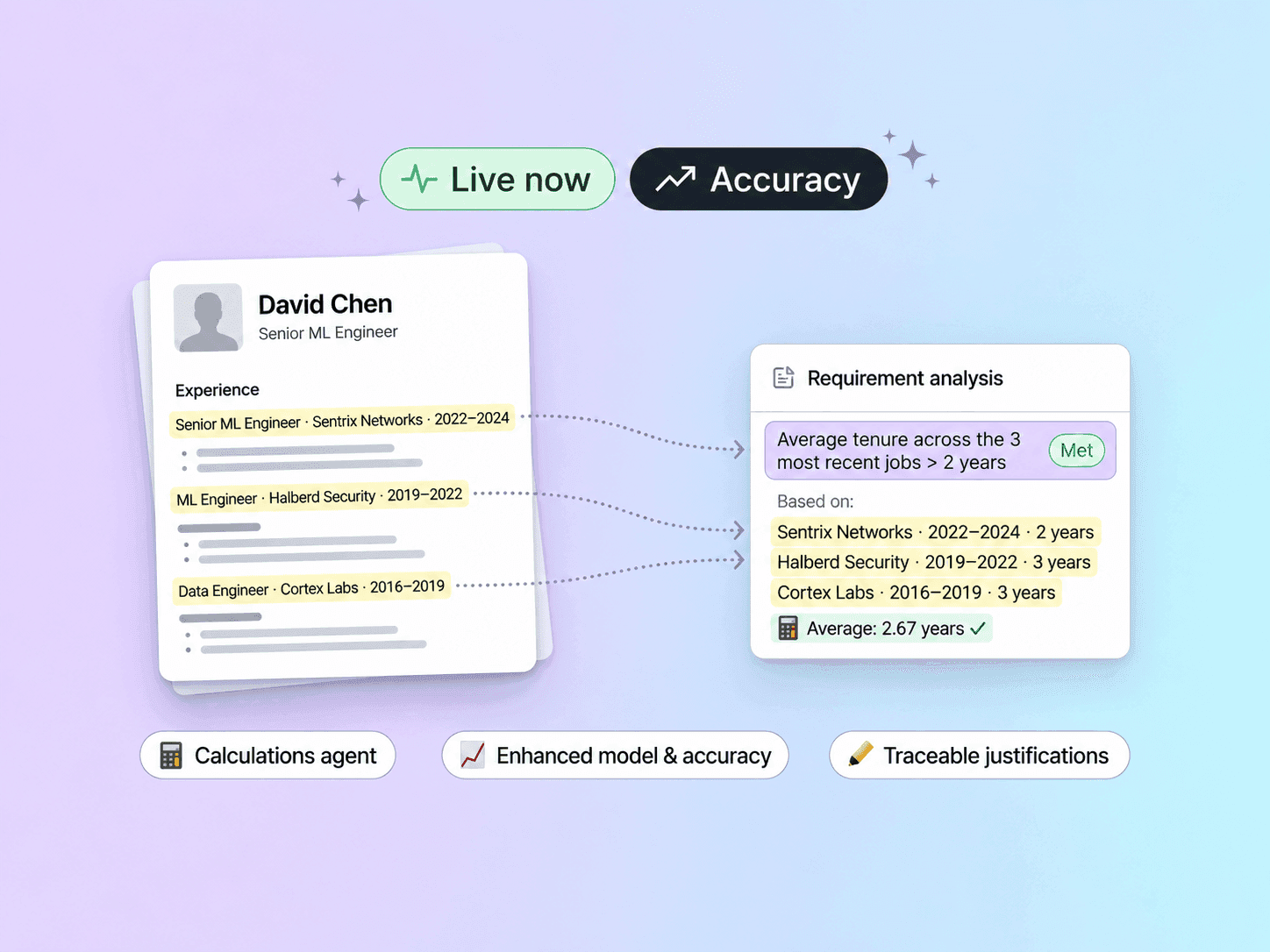
A new analysis engine, with a calculations agent and CV-anchored justifications
Screening a CV against a job description is one of those tasks that sounds simple until you look at it closely. Some requirements are qualitative and need judgment: "strong written communication skills", "experience selling to enterprise buyers". Others are quantitative and demand precision: "at least 5 years of experience in a leadership role", "no more than 6 months between jobs over the last decade". And every decision has to be explainable, both to the hiring manager who asked for it and to the candidate on the other end.
That mix is exactly where standalone LLMs start to struggle. They're great at reading and interpretation. They're less great at math, at not confusing similar dates, and at telling you exactly where in a document they got an answer from. This release is about closing those gaps.
Here's what's new.
A new model powering the engine
We upgraded the model behind Brainner's analysis engine. The short version: better reasoning, better handling of long and messy CVs, and a stronger baseline on every kind of requirement we evaluate. This alone moves the needle on accuracy across the board.
A calculations agent for the math-heavy work
On top of the new model, we added a dedicated calculations agent for the requirements that involve computation. Things like:
- Total years of experience in a given field or industry.
- Time spent in a specific role or seniority level.
- Overlaps between positions (which can inflate or deflate real experience).
- Gaps between jobs, and how long they lasted.
- Career progression across a given time window.
Before, the model had to work these out on the fly while reading the CV. That's the kind of task where language models are known to slip: not because they don't understand the request, but because arithmetic isn't what they're designed for. The calculations agent takes those requirements out of the model's hands and runs them explicitly on the structured data extracted from the CV.
How the agents work
The engine only calls on an agent when a requirement actually needs it. For a straightforward check like "holds a Bachelor's degree in Engineering", the model resolves it directly. But when a requirement involves math that the model would otherwise have to estimate (say, "more than 5 years of B2B SaaS sales experience, with at least 2 in a leadership role"), it hands off to the calculations agent, which pulls the relevant dates from the CV and computes the answer.
The upside is twofold. First, precision: math is done as math, not as a guess. Second, efficiency: agents don't fire on simple requirements, so response times stay fast and the analysis stays focused where it needs to be.
You get the best of both worlds: the model's judgment where nuance matters, and deterministic math where precision matters. Together, this architecture outperforms standalone LLMs in our internal benchmarks.
Justifications anchored to the CV
The other change in this release is one you'll probably feel every day. Every requirement justification now points to the specific section of the CV it's based on.
Until now, a justification told you why a candidate met or missed a requirement. Now it also tells you where that came from. If the engine says a candidate has 3 years of experience with Salesforce, you will have the lines in the CV that back that up. No more scanning the document to double-check.
In practice, this means:
- Faster review. No need to hunt down where each conclusion came from.
- More transparency. You can see how the engine reached each evaluation.
- Easier to defend. Whether it's a hiring manager questioning a score or a candidate asking why they were passed over, the answer is one click away.
For teams working under audit requirements or bias-related regulations, this also means a much cleaner trail: every decision has evidence attached to it, at the requirement level.
Why this direction matters
Zooming out for a second: this release is the first big step in a broader shift for the analysis engine, toward an agentic architecture where the model acts as the orchestrator and specialized agents handle the parts of the work that need specific tools or logic.
Calculations are one of those. There will be more. Each new agent we add will follow the same principle: only run when it adds value, and always in service of a more accurate and more explainable evaluation. That way, as the engine gets more capable, it also stays predictable and fast.
Live in all accounts
These changes are already active across every account. There's nothing to configure. The next time you analyze a role, you'll see the justifications linked to the CV and the calculations handled by the new agent.
As always, if you spot something we can improve or want to share how it's working for you, reach out. Every piece of feedback helps us keep tuning the engine.
If you have any questions, please email us at support@brainner.ai.
Continue reading

How IMO Health Screens Thousands of Healthcare IT Applicants and Catches Fake Ones
IMO Health's TA team screens thousands of healthcare IT applicants per role with Brainner. See how they surface top candidates and catch fakes.

How Rachel at Quandri Technologies Screened 2,000 Resumes Without Missing Top Candidates
Rachel at Quandri Technologies screened 2,000 applicants in record time with Brainner, without missing top candidates. See how she got her time back.
Save up to 40 hours per month
HR professionals using Brainner to screen candidates are saving up to five days on manual resume reviews.