
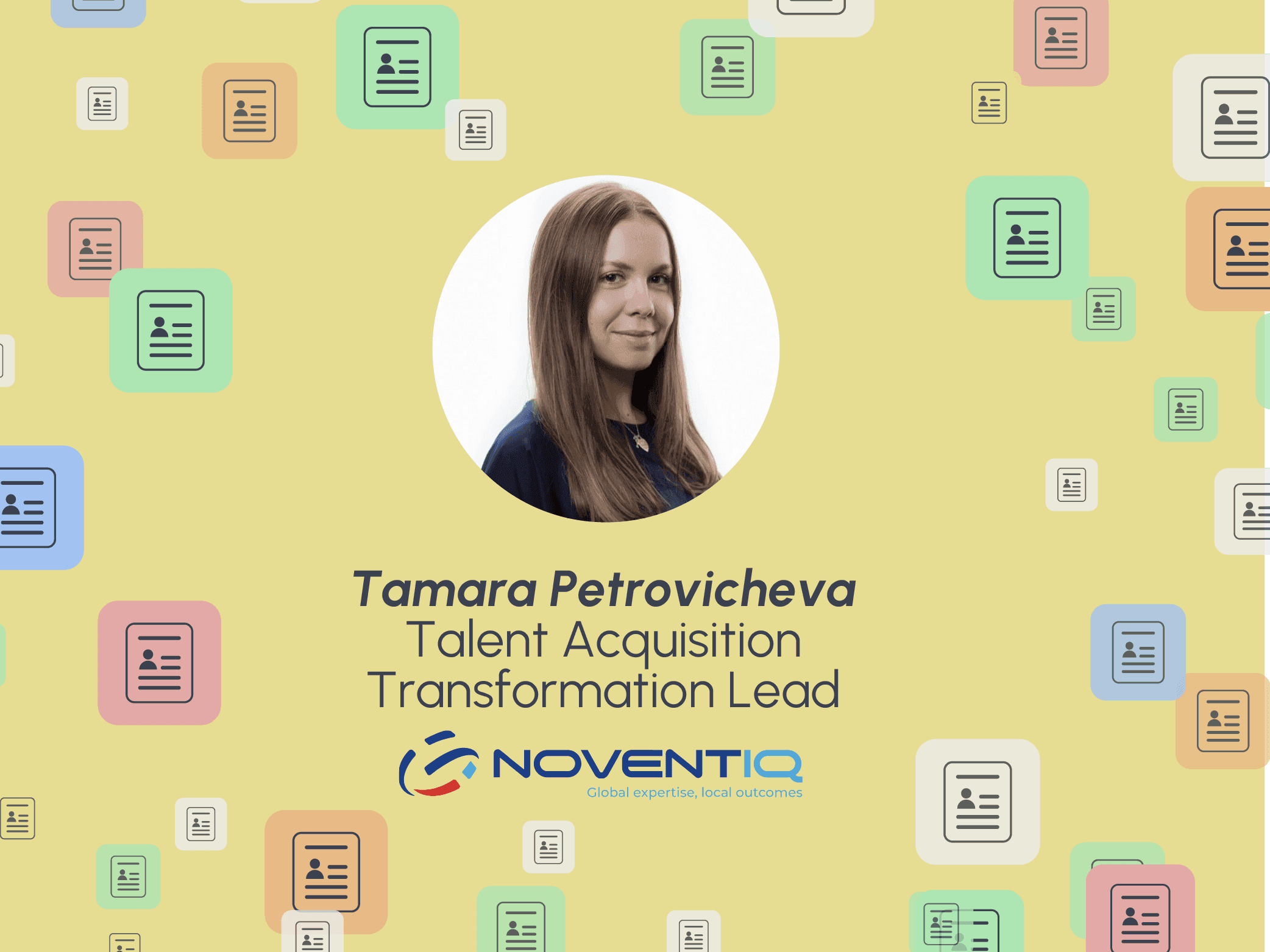
6,400 employees. Up to 100 legal entities. Multiple countries.
Implementing new recruiting technology in an organization this complex is anything but straightforward.
Different regions operate with different structures. Recruiting teams have their own workflows. Legacy HR systems create integration challenges. And any new tool needs to deliver consistent results without forcing everyone to completely change how they work.
That’s the environment in which Noventiq implemented Brainner.
And according to Tamara Petrovicheva, who leads Global Talent Acquisition Transformation at Noventiq, the experience stood out from other AI resume screening solutions she had evaluated.
“I’ve tried a lot of AI CV screeners, and I can say Brainner is one that stuck.”
What made the difference wasn’t simply screening speed.
It was the combination of precision, recruiter control, ease of use, and dedicated Customer Success support that made Brainner suitable for a complex global recruiting operation.
Meet Noventiq: Recruiting at Enterprise Scale
Noventiq is a global IT consulting and digital transformation company operating across multiple international markets.
Its business brings together technology consulting, IT services, and solutions delivered through a geographically distributed organization.
As Tamara explains:
“We are a global IT consulting company with around 6,400 employees across six-plus countries.”
And the complexity doesn’t stop there.
“Our setup is genuinely complex: multiple regions, up to 100 legal entities, all with their own structures.”
For an enterprise like Noventiq, adopting recruiting technology isn’t just about selecting a product with the right features.
It’s about finding something that works across different teams, hiring requirements, organizational structures, and existing systems.
As Tamara puts it:
“When I tell you a tool works for us, it’s been through a real test.”
The Enterprise Challenge: Scaling Resume Screening Without Losing Precision
When companies receive thousands of applications across different regions, manual resume screening quickly becomes a bottleneck.
But for large enterprises, speed alone isn’t enough.
Different positions require different skills. Recruiters need to distinguish mandatory qualifications from preferred experience. Hiring managers may prioritize certain requirements differently depending on the business unit or location.
And the consequences of inaccurate screening can be significant.
A qualified candidate might be overlooked because their experience doesn’t match a rigid keyword search.
Another candidate might appear relevant based on a generic AI score despite missing a critical requirement.
Enterprise recruiting teams need more than an AI tool that reads resumes quickly. They need one that evaluates candidates accurately against their specific requirements.
For Tamara, this was the key differentiator.
“The real difference is the weightage option on every single requirement.”
Why Brainner’s Criteria-Driven Screening Makes the Difference
Many AI resume screening tools promise to identify the best candidates automatically.
But there’s a fundamental question behind that promise:
Best according to whom?
A generic AI ranking doesn’t necessarily reflect what a recruiter or hiring manager considers important for a particular position.
Brainner takes a different approach.
Instead of generating an unexplained overall assessment, Brainner allows recruiters to define the criteria that matter for each role and determine how those criteria should influence the evaluation.
Tamara highlights this directly:
“I can set exactly how much it matters: mandatory, good to have, dial it up or down.”
This level of customization is particularly valuable for companies managing diverse hiring needs across different teams and countries.
A technical requirement might be mandatory for one position but preferred for another. Experience in a specific industry might carry significant weight for one business unit but be relatively unimportant for another.
With Brainner, recruiters can reflect those differences directly in the screening configuration.
The recruiter defines what matters. Brainner evaluates candidates against those requirements.
And rather than relying on a black-box score, the platform provides explanations behind its assessments, helping recruiters understand why a candidate meets, partially meets, or doesn’t meet each criterion.
For Tamara, this is what separates Brainner from other solutions:
“This level of control is really rare, and I can say it’s what makes the results actually accurate and precise, not just fast.”
Beyond Speed: What Makes Brainner’s AI Resume Screening More Precise?
At Brainner, we believe accurate resume screening requires more than a powerful language model.
Our approach combines several capabilities:
- Criteria-driven semantic analysis: Instead of relying on keyword matching or generic AI scores, Brainner evaluates candidates against recruiter-defined mandatory and preferred requirements, with configurable weights and transparent explanations.
- Candidate and company enrichment: Brainner adds relevant context about companies, industries, and professional experience to evaluate requirements that aren’t always explicitly explained in a resume.
- Specialized AI agents and calculators: Dedicated evaluation logic handles requirements involving calculations, employment timelines, years of experience, and other structured assessments that generic LLM evaluations may struggle with.
Together, these capabilities help recruiters make more informed decisions while maintaining control over the screening process.
The goal isn’t simply to screen faster. It’s to identify the right candidates more accurately.
Enterprise Implementation: Easy Adoption Across Teams and Countries
Even the most sophisticated AI screening platform has limited value if recruiters struggle to adopt it.
For a company like Noventiq, introducing new technology means working with teams across different regions, existing processes, and organizational structures.
That’s why ease of use and implementation support are essential.
Tamara emphasizes how quickly the team became comfortable with Brainner:
“It’s really easy to use. The team picked it up fast, no fight.”
Recruiters shouldn’t need extensive technical knowledge to configure screening requirements or understand candidate evaluations.
Brainner is designed to let teams define their criteria, review results, and incorporate AI screening into their existing workflows.
Customer Success That Goes Beyond Technical Support
At Brainner, Customer Success isn’t simply about answering support tickets.
Our team works directly with customers to configure screening workflows, onboard recruiting teams, and adapt the platform to their processes.
For global enterprises, this means helping different teams across countries adopt a consistent approach to AI resume screening while accommodating their specific hiring requirements.
Tamara specifically recognizes this contribution:
“The team picked it up fast, no fight, and of course with great support from the Customer Success team at Brainner.”
We believe this hands-on approach is essential for enterprise AI adoption.
A successful implementation isn’t just about deploying software. It’s about making sure recruiters actually use it and get value from it.
Integrating Brainner with Darwinbox: A Custom Enterprise Integration
Large enterprises don’t always have the flexibility to replace their existing HR systems just to introduce a new recruiting capability.
Noventiq uses Darwinbox as its HRMS, and Brainner worked directly with its team to develop a custom API integration tailored to Noventiq’s specific requirements and existing workflows.
Rather than requiring Noventiq to change its recruiting infrastructure, Brainner took responsibility for building the integration needed to incorporate AI resume screening into its existing environment.
Tamara highlights how straightforward the result was:
“Even with our old HRMS, we integrated Brainner through the API, and it just works.”
This is particularly important for enterprise organizations operating across multiple regions and legal entities.
Enterprise AI solutions should adapt to a company’s existing infrastructure, not force the company to rebuild its processes around the software.
Why Brainner Is Built for Enterprise Recruiting
Noventiq’s experience illustrates what large organizations should expect from AI resume screening software.
Speed is necessary, but it isn’t enough.
Enterprise recruiting teams also need:
- Precision and control: Criteria-driven evaluations, configurable weights, and transparent results.
- Ease of adoption: An intuitive platform that recruiters across different teams can start using quickly.
- Flexible integrations: The ability to connect with existing ATS and HRMS platforms, including custom API integrations.
- Hands-on Customer Success: Dedicated support to configure workflows, onboard teams, and drive adoption across the organization.
These capabilities are especially important when deploying AI across complex, multinational recruiting operations.
From AI Experimentation to a Tool That Sticks
Perhaps the strongest part of Tamara’s testimonial is that Brainner wasn’t the first AI resume screening tool she evaluated.
“I’ve tried a lot of AI CV screeners, and I can say Brainner is one that stuck.”
For us, that’s what matters most.
Not simply demonstrating that AI can screen resumes, but building a solution that recruiting teams continue using because it delivers meaningful value in their daily operations.
Tamara closes with a recommendation for other enterprise recruiting teams:
“If you are a large enterprise drowning in applications, with great candidates slipping through the cracks, this is the tool that fixes it.”
Because enterprise AI resume screening shouldn’t force companies to choose between speed, precision, and control.
They should be able to have all three.
Save up to 40 hours per month
HR professionals using Brainner to screen candidates are saving up to five days on manual resume reviews.