
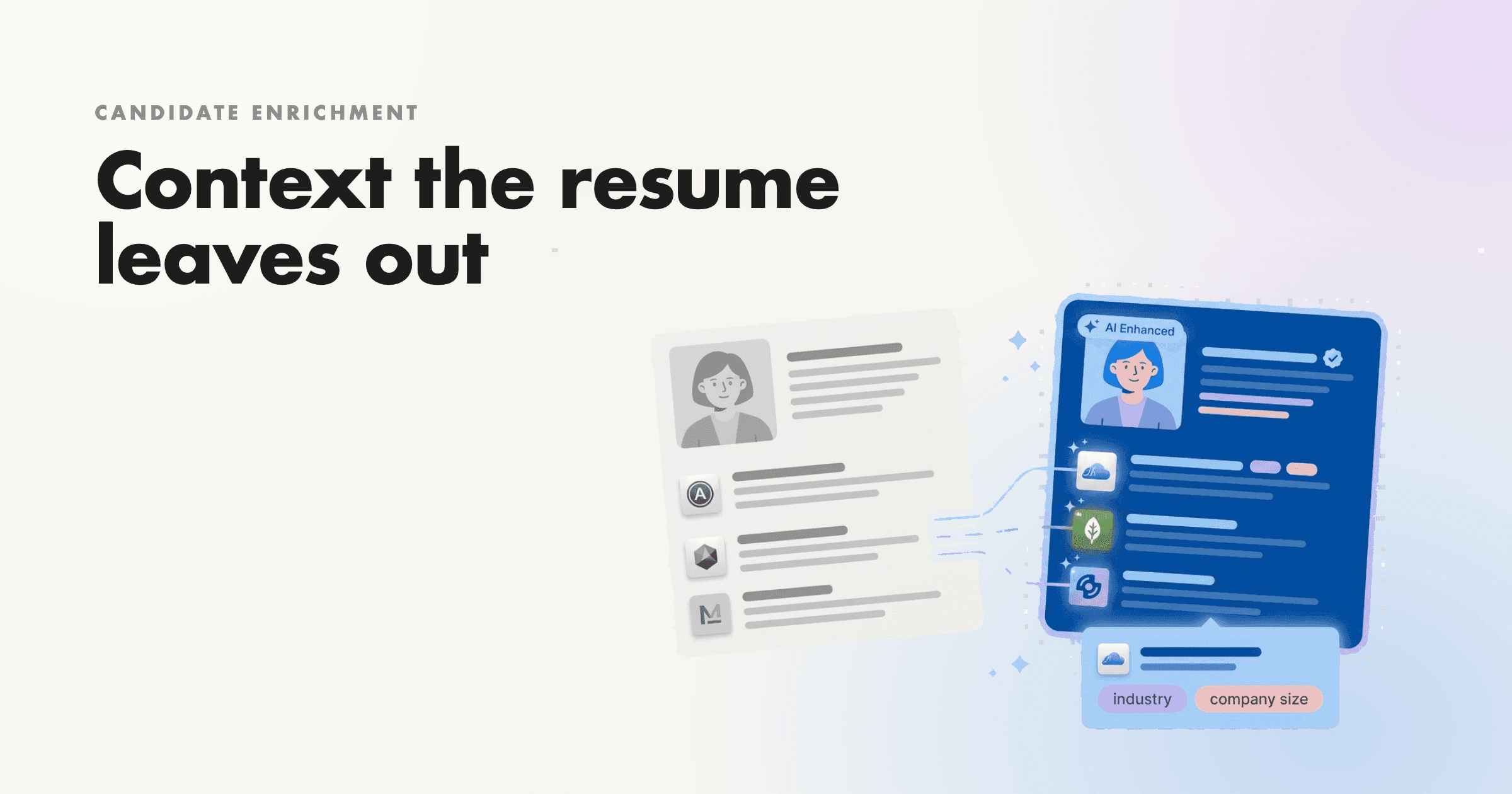
A resume tells you where someone worked. It rarely tells you what that work involved. "Senior engineer at a fintech" reads very differently once you know the company was a 200-person Series B scaling payments across ten markets, not a 10,000-person bank. That context changes how you evaluate the candidate, but it is not on the resume, and finding it by hand for every applicant does not scale.
Candidate enrichment closes that gap. It adds the context a resume leaves out, so you can evaluate candidates on what their experience actually means, not just on what they wrote. This guide explains what candidate enrichment is, how it works, where it helps most in recruiting, and how to evaluate a tool before you adopt one.
TL;DR
Candidate enrichment adds context to a candidate's profile beyond what they submitted, so recruiters can evaluate what their experience actually means, not just what the resume says.
- The most useful enrichment for screening is company context: matching each employer on the resume to the real company and attaching details like industry and size to the profile.
- It turns an employer name into usable signal. "Engineer at a fintech" becomes "engineer at a 200-person Series B scaling payments," which changes how you evaluate fit.
- Enrichment is not the same as resume parsing or data cleansing. Parsing reads one document, cleansing fixes existing data, enrichment adds new context.
- Done well, it makes screening faster and more accurate on every applicant, without manual research, and keeps the recruiter in control of the decision.
- When evaluating a tool, look at where the context comes from, whether it shows inside the profile, and whether the recruiter stays in control.
What is candidate enrichment?
Candidate enrichment is the process of adding context to a candidate's profile beyond what they submitted, so recruiters can evaluate them more accurately. Instead of working only from the resume, an enriched profile also carries structured information about the companies the candidate worked for, their roles, and other signals that put their experience in context.
The most useful enrichment for screening is company context. A resume lists employers as names, but those names carry meaning a recruiter has to infer: how big the company is, what industry it operates in, what kind of scale or environment the candidate likely worked in. Enrichment makes that explicit. It matches each employer on the resume to the real company, then attaches details like industry and size directly to the profile, where they are easy to read while reviewing the candidate.
Candidate enrichment and candidate profile enrichment describe the same idea. The goal is not to collect more data for its own sake. It is to give recruiters, and the AI that assists them, enough context to judge fit well, on every applicant, without manual research.
Candidate enrichment vs. resume parsing vs. data cleansing
These three terms often get used interchangeably, but they solve different problems. Knowing the difference helps you understand what your candidate data actually needs.
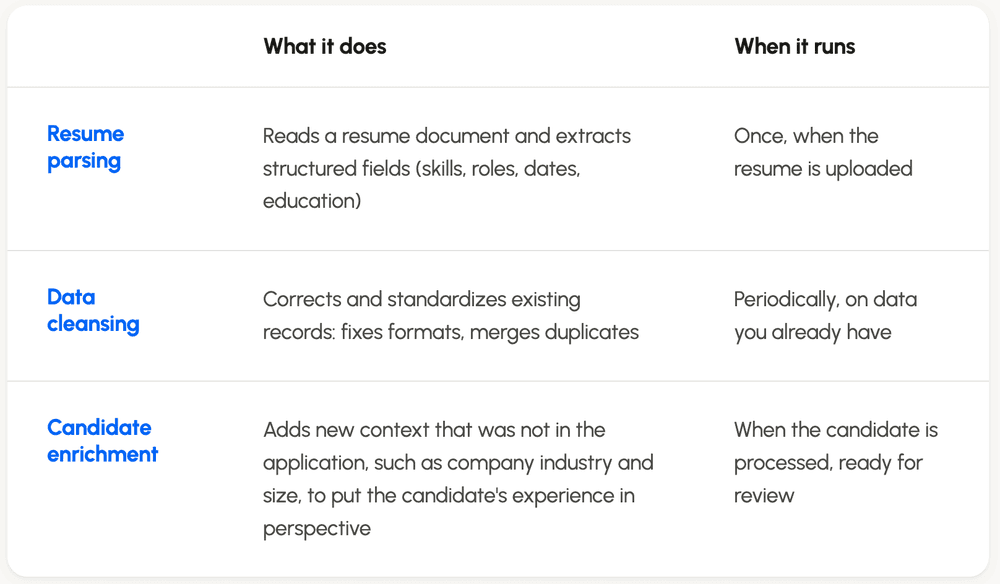
Resume parsing is the starting point. It turns a document into structured data, but it can only work with what the candidate wrote. If the resume says "Software Engineer at Northwind Pay," parsing captures that text, and nothing more.
Data cleansing keeps existing records tidy. It fixes a phone number format or merges two profiles for the same person, but it does not add anything new. A clean record can still be missing the context you need to evaluate someone.
Candidate enrichment is the layer that adds context. It takes "Software Engineer at Northwind Pay" and attaches what that means: a payments company, a certain size, a certain industry. That is the difference between reading what a candidate wrote and understanding what their experience represents.
The context a resume leaves out
A resume is written to be concise, so it leaves out most of the context that would help you evaluate it. It lists an employer, a title, and a few bullet points, and expects the reader to fill in the rest. For a recruiter reviewing hundreds of applications, filling in that rest by hand is not realistic.
Consider two candidates who both list "Backend Engineer, three years." One worked at a 50-person startup where they owned the entire stack and shipped to production weekly. The other worked at a 20,000-person enterprise on a single component of a much larger system. Same title, same tenure, very different experience. The resume does not tell you which is which. The company does.
This is the context enrichment recovers:
- Company size: whether the candidate worked at startup scale or enterprise scale, which shapes the breadth and autonomy of their role.
- Industry: whether their experience is in a relevant sector, and whether the environment matches the kind of role you are filling.
- Company type: the difference between a high-growth company scaling fast and an established one with mature processes.
None of this is a judgment on the candidate. It is context that helps you read their experience accurately, so a strong candidate from an unfamiliar company is not overlooked, and a familiar logo does not get more credit than the actual work deserves.
Two approaches to enrichment
Not all candidate enrichment does the same thing, because it depends on what data gets added and what it is for. Broadly, enrichment falls into two purposes.
The first is enrichment for outreach and sourcing: adding contact details and profile data so recruiters can reach candidates and build lists. This is useful when the goal is to find and contact people.
The second is enrichment for evaluation: adding context that helps you judge fit, so screening is more accurate. This is where company context matters most. Knowing that a candidate scaled systems at a high-volume payments company, or led a team at an enterprise, tells you something about their experience that a contact record never will.
Brainner's enrichment is built for the second purpose. It focuses on the company context behind each role, so the added information feeds directly into how candidates are evaluated against your criteria. The point is not a more complete contact card. It is a clearer read on what the candidate has actually done.
How company context sharpens screening
Enrichment matters most at the screening stage, because context changes how you evaluate a candidate against your criteria. AI resume screening ranks candidates by how well they fit a role. The quality of that ranking depends on how much the system actually understands about each candidate, and a resume alone leaves a lot unsaid.
Company context fills specific gaps that come up constantly in screening:
- "Scaled systems at high volume." A criterion like this is hard to verify from a resume. Knowing the candidate worked at a company handling millions of transactions makes it credible in a way the job title alone does not.
- "Experience in a regulated industry." The resume may not spell out that a past employer was in healthcare or finance. Company context does, so relevant industry experience is not missed.
- "Startup environment." If you are hiring for a small, fast-moving team, a candidate who thrived at a 30-person company may fit better than one from a large enterprise, even with an identical title. Context surfaces that difference.
The result is a more accurate evaluation on every applicant, not just the ones whose employers a recruiter happens to recognize. Enrichment does the background research automatically, so criteria that depend on company context can be assessed consistently across the whole applicant pool. And because the context is attached to the profile with its source, the recruiter can see why a candidate matches and stays in control of the decision. The AI assists the evaluation; the recruiter decides.
What to look for in candidate enrichment
If you are evaluating a tool that offers candidate enrichment, the details matter more than the label. Strong candidate enrichment should:
- Add context that helps you evaluate, not just contact. The most useful enrichment for screening is company context (industry, size, type), because it changes how you read a candidate's experience. Data that only helps you reach someone is a different job.
- Match employers accurately. Enrichment is only useful if it connects each role to the right company. Ask how the tool resolves company matches and what happens when a match is uncertain.
- Show the context inside the profile. The enriched information should sit alongside the candidate's experience where you review it, not in a separate list where you lose the connection between a role and its context.
- Feed the evaluation. The best enrichment does not just display extra data, it makes it usable, so criteria that depend on company context can be assessed as part of screening.
- Keep the source visible. You should be able to see where a piece of context came from, so you can trust it and stay in control of the decision rather than accepting a number at face value.
- Work with the data you already have. Enrichment should run on the candidates already in your pipeline, adding context to real applicants rather than creating extra manual steps.
If a tool adds data you cannot trace, or presents it in a way that is disconnected from the actual review, the extra information creates noise instead of clarity.
How Brainner enriches candidate profiles
Brainner enriches candidate profiles as part of screening, using the companies on each resume to add context that supports evaluation. It works in a few steps.
1. Match the employer to the real company. When a resume comes in, Brainner takes the companies the candidate listed and matches them to the real organizations behind those names.
2. Add company context. With the match made, Brainner attaches structured details about each company, such as industry and size, directly to the candidate's experience. You see this in context: alongside each role, with the company identified rather than left as plain text.
3. Feed it into the evaluation. That context becomes part of how candidates are assessed against your criteria, so requirements that depend on company signals (scale, industry, environment) can be evaluated, not just guessed at from a job title.
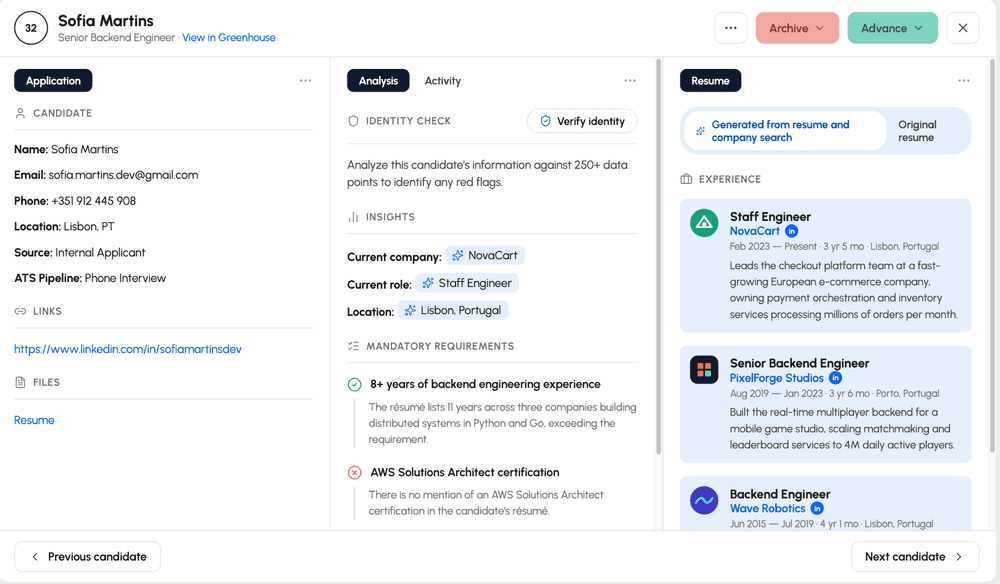
Throughout, the enriched profile sits next to the original resume, so you can always compare what the candidate submitted with the added context. Brainner surfaces the context and its source; you review it and make the call. The enrichment supports the decision, it does not make it.
Want to see enriched candidate profiles on your own roles? Book a demo or start a free trial and review your applicants with company context built in.
FAQs
Common questions about candidate enrichment and how it works.
Candidate enrichment is the process of adding context to a candidate's profile beyond what they submitted, so recruiters can evaluate their experience more accurately. The most useful enrichment for screening is company context: matching each employer on the resume to the real company and attaching details like industry and size. Candidate enrichment and candidate profile enrichment describe the same practice.
A candidate profile is the record of a candidate in your hiring system, combining what they submitted (resume, application answers) with any additional context added during the process. An enriched candidate profile goes further than the resume by including context such as the industry and size of the companies where the candidate worked.
Resume parsing reads a resume and extracts structured fields from it, such as skills, roles, and dates. It can only work with what the candidate wrote. Candidate enrichment adds new context that was not on the resume, such as the industry and size of past employers, so you understand what the experience represents rather than just what was written.
No. Enrichment adds context and surfaces its source, so the recruiter has a clearer picture when evaluating a candidate. The recruiter still reviews the profile and makes the final decision. The AI assists the evaluation; it does not make the call.
For screening, the most valuable context is company-level: the industry a past employer operates in, its size, and its type. This helps put a candidate's roles in perspective, so a title like "engineer at a fintech" becomes something you can actually evaluate against your criteria.
Yes. Enrichment runs on the candidates in your pipeline, so it works with the applicant tracking system you already use. Brainner connects with Greenhouse, Lever, Workday, iCIMS, BambooHR, Workable, Recruitee, JazzHR, SmartRecruiters, Ashby, Zoho Recruit, and Teamtailor, adding company context to the profiles you review.
Still have questions?
Book a demo or .
Continue reading

AI Recruiting Agents: The Future of Hiring Without Losing Human Control
AI recruiting agents are transforming hiring by automating resume screening, sourcing, and interview scheduling—saving recruiters 90% of their time while keeping humans in control of final decisions. Discover how Brainner’s AI-powered tools help recruiters work smarter, not harder, without losing transparency or fairness. 🚀

Candidate screening for staffing agencies: how to take on more roles without adding recruiters
How staffing agencies and RPOs screen candidates at scale, hit client SLAs, reuse their candidate database, and flag fraud, all on top of their ATS.
Save up to 40 hours per month
HR professionals using Brainner to screen candidates are saving up to five days on manual resume reviews.