
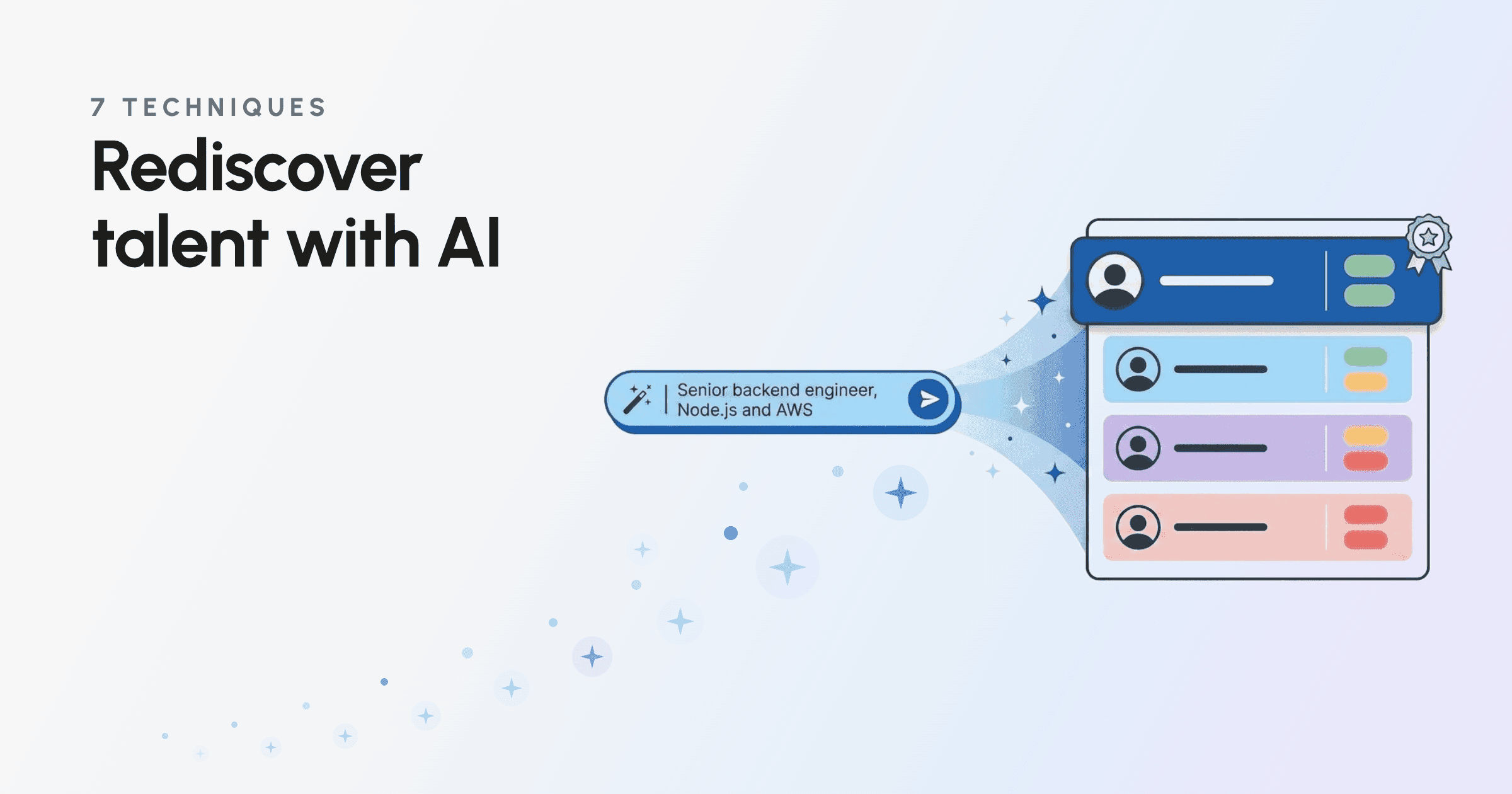
Your next hire may already be in your database. Every role you open adds hundreds of applicants you paid to attract, screened with your team, and in many cases interviewed. Then the role closes, and all of that work goes dormant. AI talent rediscovery puts it back to work: instead of sourcing a stranger from scratch, you re-screen the candidates you already have against your new role and surface the strongest matches in minutes.
This is a practical guide to seven techniques that make rediscovery accurate, not just a keyword search over old resumes. If you want the full primer on what rediscovery is and when to use it, start with our guide to candidate rediscovery. Here, the focus is the how: the specific techniques that turn a passive database into your fastest pipeline, and the role AI plays in each one.
What is AI talent rediscovery?
AI talent rediscovery is the practice of using AI to re-screen candidates already in your database against a new open role, instead of sourcing new candidates from scratch. It reads each candidate's full history (resume, application answers, tags, and feedback from previous interviews) and evaluates them against your role's criteria, then surfaces the strongest matches with the evidence behind each one.
The "AI" part matters because standard database search does not do this. Keyword and Boolean filters only return candidates who used the exact words in your query, so a strong engineer who wrote "built data pipelines" instead of "ETL" never surfaces. AI talent rediscovery uses semantic search to read meaning and context, then ranks candidates by how well they fit the role you are filling now, not the one they originally applied to. You set the criteria and weights, and you make the final call.
Talent rediscovery and candidate rediscovery describe the same practice. The techniques below apply whether you run an in-house team or a staffing agency, and whether your database holds a few thousand candidates or a few million.
Why your best candidates are already in your database
The average corporate job posting receives more than 350 applications, and only a handful ever reach an interview. The rest, many of them qualified, stay in your database and are never looked at again. You paid to attract every one of them and spent your team's time screening them. When the next similar role opens, sourcing a stranger from scratch means paying for that same work twice.
Starting with people who already applied changes the math in three ways:
- They know your company, so they respond faster than cold outreach.
- They have already been screened once, so you have history and context to work from.
- They move quicker, because there is less to explain and less to sell.
The reason this channel stays underused is not that the candidates are gone. It is that most database search relies on exact keyword matching, so a strong candidate who worded their experience differently from your filter simply never appears. The database is not empty. It is unsearchable with the wrong tools, which is exactly what AI talent rediscovery fixes.
Talent rediscovery vs. sourcing vs. talent pipeline
These three terms get used interchangeably, but they describe different things. Understanding the difference helps you decide which move a given role calls for.
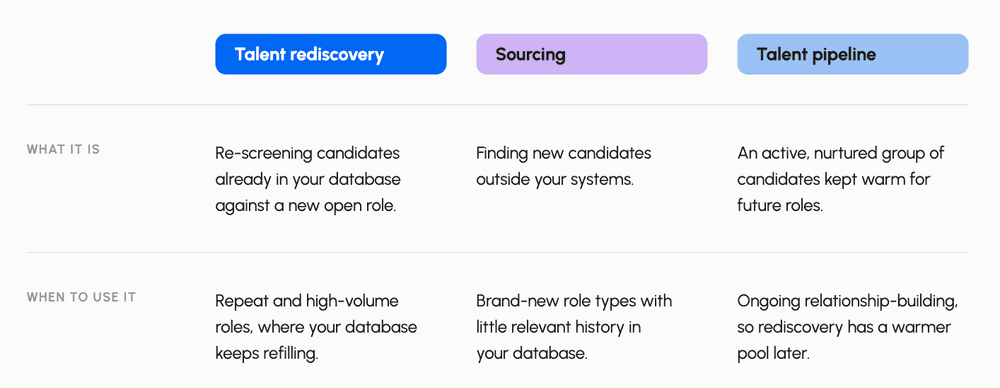
Rediscovery is not a replacement for sourcing, and a talent pipeline is not a substitute for either. They work together: rediscovery gives you warm, pre-evaluated candidates today, sourcing brings new talent into your database for tomorrow, and a healthy pipeline keeps the strongest past candidates engaged in between. The honest rule is to check your own database first for repeat and high-volume roles, then source externally for the gaps.
7 AI talent rediscovery techniques
Rediscovery done well is a repeatable method, not a lucky search. These seven techniques cover how to find the right candidates in your database, how to judge them against the role you are filling now, and how to reach back out so they actually respond.
1. Search your database in plain language, not Boolean
Boolean strings and exact-match filters only surface candidates who used your exact words, so most of your qualified talent stays invisible. Instead, describe who you need the way you would explain it to a colleague: "past applicants for a senior backend role with Node.js and AWS experience." AI reads the intent behind the request and searches the meaning of every profile, not just the keywords. In Brainner, you can also start from an existing job posting or attach a resume to find similar profiles, so the search begins from something you already have.
2. Re-screen against the new role, not the old job's keywords
The most common rediscovery mistake is matching candidates to the role they originally applied to. A near-miss for last year's position may be a strong fit for this one, and someone who looked perfect then may not match now. Re-screen the segment against the new role's actual criteria, separating must-haves from preferred qualifications, and let semantic search surface candidates with equivalent experience even when they worded it differently. A candidate who wrote "built data pipelines" should surface for an ETL requirement. This is where AI talent rediscovery earns its name: it evaluates fit for the role in front of you, not the one in the archive.
3. Read the evidence behind every match
A ranked list is only useful if you can see why each candidate is there. Good rediscovery shows the reasoning: for each candidate, you should see where they are a strong match, a partial match, and where there is a gap, with the evidence from their history attached. Brainner evaluates every candidate against your criteria one column at a time, and each cell shows the evidence behind the Match. You are not trusting a black-box number; you are reviewing the same evidence you would want from a brand-new applicant, which is what lets you make the call with confidence.
4. Prioritize silver medalists and finalists first
Not every past applicant is worth the same attention. Start with the candidates who already got closest: silver medalists who reached the final stages and lost to a slightly stronger fit, and near-misses screened out for timing or a single missing requirement rather than for quality. These candidates are the most pre-vetted talent you have and usually the fastest to move, because you already have interview history and context on them. Rank by fit against the new role, then work down from your strongest matches.
5. Build living candidate pools by role family
Rediscovery is faster when you are not starting a search every time. Build curated pools around the profiles you hire for repeatedly: your strongest React candidates, every finalist for support roles, 100 vetted .NET developers. In Brainner, these pools are living segments that update as your database grows, so when a hiring manager or client arrives with an urgent request, you are opening a pool instead of starting from zero. Staffing agencies can answer "do you have anyone for this?" the same day. In-house teams stop re-sourcing the same profiles every quarter.
6. Refine in natural language and keep the decision yours
Your first result set is a starting point, not a verdict. Narrow it the way you think: ask for "more candidates like Daniel and Priya," or add a new criterion without rerunning the whole search. The AI adjusts the ranking; you decide who is worth reaching out to. This is the line that matters most in rediscovery: AI surfaces and ranks the candidates and shows its evidence, and the recruiter reviews that evidence and makes the final call. The goal is a faster shortlist you trust, not a decision handed to a model.
7. Re-engage with context, not cold outreach
The advantage of rediscovery disappears if your outreach reads like a mass email. Reach out with a specific reason this new role fits them, and reference where they got to last time. Past applicants already know your brand, and strong candidates often stay open to new opportunities for months after their original process, particularly when the message is specific and acknowledges their prior experience with your team. Personalized, context-aware outreach is what separates rediscovery from spamming an old list.
What to look for in talent rediscovery software
Most tools that claim to do rediscovery are really sourcing platforms that pull in external profiles. If your goal is to put the candidates you already have to work, the checklist is different. Strong talent rediscovery software should:
- Search by meaning, not keywords. Semantic search across your full database, so candidates surface even when their wording differs from your query.
- Re-screen against your criteria. Evaluation against the new role's must-haves and preferred qualifications, ranked by fit, rather than a flat keyword count.
- Show the evidence. A visible reason for every match, so you can review each candidate the way you would a new applicant instead of trusting a score.
- Keep the recruiter in control. The tool surfaces and ranks; you set the criteria and weights and make the final decision.
- Work with your existing data. No scraped profiles or third-party contact data. Rediscovery should run on candidates who applied to you directly.
- Meet real compliance standards. SOC 2 Type II, plus GDPR and CCPA alignment, so re-engaging past candidates does not create a data-protection problem.
- Build reusable pools. Living segments you can return to, so recurring roles do not mean starting a new search each time.
How Brainner does AI talent rediscovery
Brainner runs rediscovery on the database it has already analyzed, using every candidate's full context: resumes, application answers, tags, and feedback from previous interviews. It works in three steps.
1. Chat with your database. Describe who you need in plain language, start from a job posting, or attach a resume to find similar profiles. No Boolean strings, no exact-match guesswork.
2. See why each candidate matches. Every candidate is evaluated against your criteria, one column at a time. Each cell shows the evidence behind the Match, so you see strong matches, partial matches, and gaps at a glance.
3. Refine and decide. Narrow the pool in plain language, like "find more like Daniel and Priya," or add a criterion without rerunning the search. You review the evidence and make the call.
Every candidate Brainner screens is indexed with full context, so today's applicants become tomorrow's rediscovery results: screening builds the database, and rediscovery puts it to work on every new role. Brainner is SOC 2 Type II certified and built for GDPR and CCPA compliance, and your database is never used to enrich anyone else's. You set the criteria and the weights, and you keep the final decision.
Want to put the candidates you already have to work? Start a free trial or book a demo to see rediscovery on your real roles.
FAQs
Common questions about talent rediscovery and how it works.
AI talent rediscovery is the practice of using AI to re-screen candidates already in your database against a new open role, instead of sourcing from scratch. It reads each candidate's history and evaluates them against your role's criteria, then surfaces the strongest matches with the evidence behind each one. Talent rediscovery and candidate rediscovery describe the same practice.
Sourcing finds new candidates outside your systems. Rediscovery finds qualified candidates already inside them. They work together: rediscovery gives you warm, pre-evaluated candidates in minutes, while sourcing brings new talent into your database for future searches.
A silver medalist is a candidate who reached the final stages of a past hiring process but was not selected, usually because another candidate was a slightly better fit. Silver medalists are already vetted and familiar with your company, so they can often be hired faster when a matching role opens.
Standard ATS search usually relies on keyword and filter matching, so a strong candidate listed as "backend developer" may never appear in a search for "Node.js engineer." AI talent rediscovery uses semantic search across your entire database and evaluates every result against your criteria, showing the evidence behind each match so you can make an informed decision.
Yes. Rediscovery depends on reading the candidate data already in your applicant tracking system, so it works with any ATS your tool integrates with. Brainner connects with Greenhouse, Lever, Workday, iCIMS, BambooHR, Workable, Recruitee, JazzHR, SmartRecruiters, Ashby, Zoho Recruit, and Teamtailor, and candidates screened directly in Brainner are indexed and searchable even without an ATS connection.
It should be, on two fronts. On privacy, rules like GDPR and CCPA govern how long you can keep candidate data and how you can reuse it, so rediscovery should only cover candidates you are still permitted to hold and contact under your retention policy. On security, the tool should meet recognized standards. Brainner is SOC 2 Type II certified and built for GDPR and CCPA compliance, and works with data candidates provided directly, not scraped profiles.
Generally yes. Past applicants already know your brand and expressed interest in working with you, so re-engagement feels like a continuation rather than cold outreach. Strong past candidates often stay open to new opportunities for months after their original process, particularly when outreach is specific and references their prior experience with your team. Project contentSEO & GEO/AEOCreated by youpdfpdfpdfContentChart.csvcsvCountries.csvcsvDevices.csvcsvFilters.csvcsvPages.csvcsvQueries.csvcsvSearch appearance.csvcsvexcerpt_from_previous_claude_message.txt1 linetxt
Still have questions?
Book a demo or .
Save up to 40 hours per month
HR professionals using Brainner to screen candidates are saving up to five days on manual resume reviews.